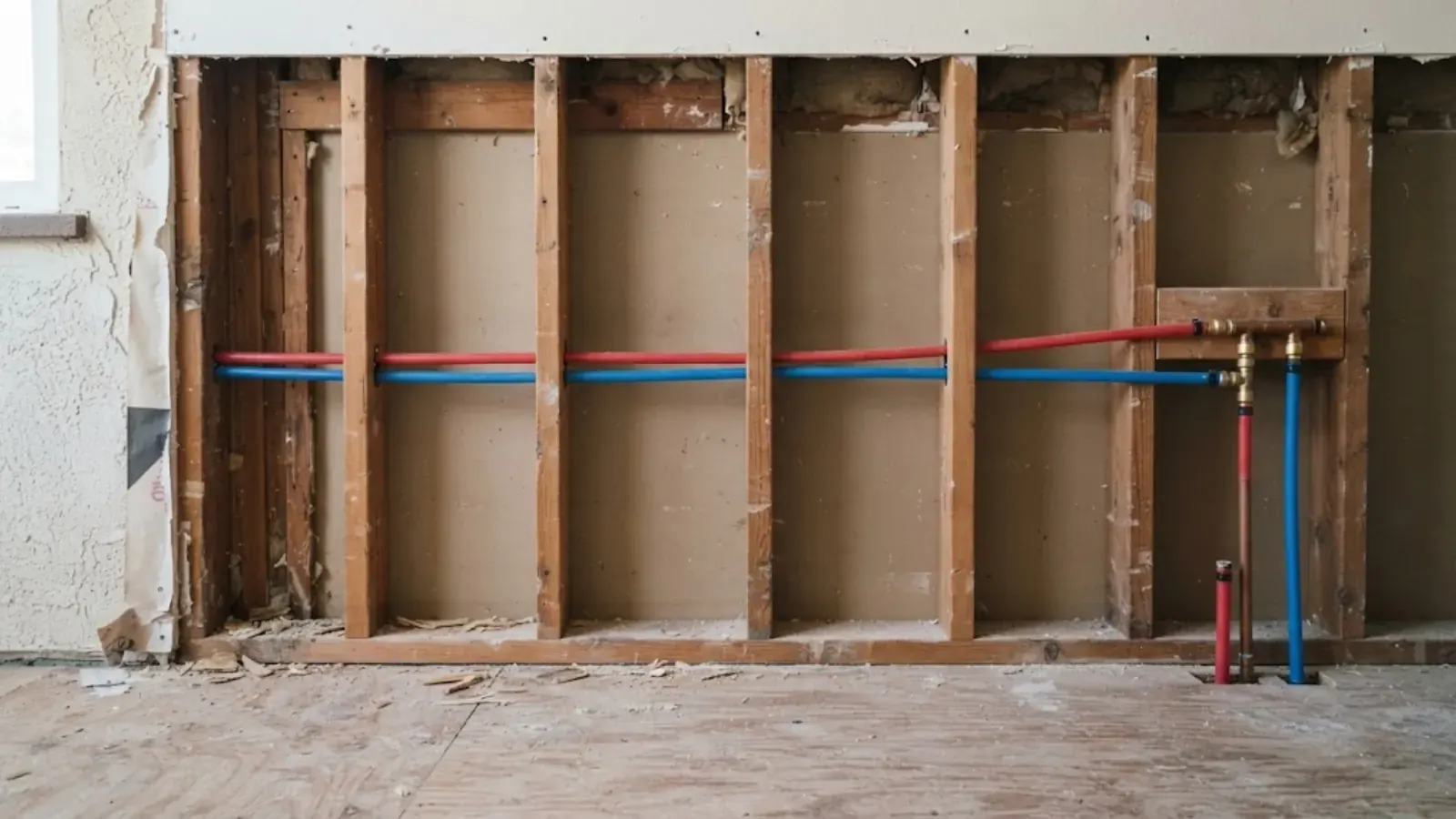
Repair or repipe: how to decide
| What is happening | What it suggests | Usual next step |
|---|---|---|
| One leak at a fitting and the rest of the line looks sound | A localized failure | Repair it, as described under burst pipe repair |
| Pinhole leaks in several rooms | Pipe walls thinning across the system | Pressure test, then a repipe quote |
| Brown water on the first draw and weak flow | Corrosion inside older steel pipe | Cut a sample section and inspect the inside |
| Low pressure at every fixture while the main valve is open | Narrowed pipes or a failing regulator | Flow test before any decision |
| Wet ground between the meter and the house | The service line, not the house piping | See water line replacement |
Repiping is a large job, so we do not recommend it on the first leak. We recommend it when testing shows a pattern of failure that repairs cannot keep up with.
Signs the pipes themselves are wearing out
Patterns that justify a closer look
- A second or third leak in separate parts of the house.
- Rust-colored water that clears slowly after the tap runs.
- Flow that is weak at every fixture, including newer ones.
- Green or white crusting at copper joints, or pinhole stains on walls.
- Repairs that keep failing next to the old pipe.
Galvanized pipe replacement
Galvanized pipe is steel coated with zinc, and it tends to rust from the inside, narrowing the passage until flow drops. That is why it can run fine for a stretch and then decline quickly. A house with galvanized lines is not an automatic repipe, and we test flow and look at cut samples before suggesting one.
Where galvanized steel meets copper, a transition fitting prevents the two metals from corroding each other at the joint. We install that fitting wherever the old and new materials meet.
Choosing the new pipe
| Material | Strengths | Cautions |
|---|---|---|
| PEX | Flexible tubing that can be pulled through walls with small openings and joined with few fittings | Needs the right fitting system for the tubing, and it should not sit in direct sunlight |
| Copper | A long record of service, rigid and good with heat | More labor to install, and it can pinhole in some conditions |
| CPVC | Rigid plastic with solvent-cement joints | Fittings can be brittle, and joints need cure time before pressure |
Which material a job can use is set by the plumbing code and confirmed with the Inspections Department, so we do not promise one before the walkthrough. We explain the tradeoffs and let you decide among the options that meet the code.
What Cary water means for pipes and softeners
Cary's testing summary lists hardness for the system that serves Morrisville at about 30 mg/L as calcium carbonate, roughly 2 grains per gallon, and classes it as moderately soft. Mineral scale from the water is therefore a modest suspect in weak flow.
Internal rust in old steel pipe is the more usual reason for brown water and falling pressure, which is why we inspect a cut sample. A softener will not repair corroded pipe, though softener and filtration options are worth a conversation if taste or spotting bothers you.
How a repipe job runs
The order is the same for most homes, though the schedule depends on house size.
- 01
Walkthrough and pressure test
We trace the existing lines, test pressure and flow, and note where walls, floors or the attic must be opened.
- 02
Plan routes and openings
New lines are routed through the least disruptive paths, and we show you where access holes will go.
- 03
Rough-in and inspection
The new lines go in, are pressure tested and are inspected where the permit requires it.
- 04
Connect, test and patch
Fixtures are reconnected, the system is flushed and tested, and the access openings are patched for finishing.
Permits, code and the water being off
The Town of Morrisville's plumbing permit page lists replacement of a plumbing system as permit work. Ask the Town of Morrisville Inspections Department at 919-463-6190 who pulls the permit and what inspections apply. Work follows the 2024 North Carolina Plumbing Code, mandatory since July 1, 2025.
Expect the water to be off for part of the working days, so plan for drinking water, cooking and bathing. We tell you when to expect it off before the job starts. Drywall patching is included in the plan, while painting and finishing are usually handled separately.
What changes the price of repiping
No two houses repipe the same way, and you get a clear price before work starts.
Size of the house
More bathrooms, floors and fixtures mean more pipe and more connections.
Pipe material
PEX, copper and CPVC differ in material and labor.
Access
Open attics and crawlspaces are quick. Finished walls and slab floors take more time.
Drywall and finish work
Openings must be patched, and the extent depends on routing.
Permits and inspections
Fees and scheduling vary, so ask the Inspections Department.
Policies generally treat repiping as maintenance of a worn system, not a covered loss, though a sudden leak damage claim can be separate. Ask your insurer before you decide.
The code behind a repipe, and the permit question
A repipe replaces a whole system, so it falls under the 2024 North Carolina Plumbing Code, based on the 2021 International Plumbing Code (IPC) with state amendments. Material choices such as PEX, copper or CPVC are made inside that code, and a licensed plumber knows which are approved for your use.
Because a repipe usually opens walls, ask the Town of Morrisville Inspections Department at 919-463-6190 whether inspection is required, and ask us who schedules it.
Call (919) 944-7281 to book a walkthrough, and ask about same-day appointments when available.
Questions we hear
Look for a pattern, not a single event. Several leaks in different places, rust-colored water and weak flow at every fixture suggest the pipes are failing. A single leak at a fitting usually does not. A pressure test settles it.
We walk through the house, trace the lines, test pressure and flow, and then give you a written, clear price before work starts. We explain which parts are needed and which are optional.
Usually not, but the water will be off for part of the working days. Plan for bathing and cooking, and tell us about anyone with special needs so we can plan around them.
Some openings are normal. Flexible tubing can be routed through small access holes, while rigid pipe may need larger ones. We show you the planned openings before we start.
Yes, when the rest of the piping tests sound. A partial repipe or reroute can address a failing section. For a slab line, see the options on our slab leak repair page.
They can restore pressure lost to corrosion or narrowed pipe. They will not raise the pressure that arrives at your meter, which is set by the water system.