Water meter still moving or the bill suddenly high
A high bill with no change in habits is the most common reason people ask us for leak detection. The Town of Cary supplies and bills water for Morrisville addresses, and its own advice for high consumption is a check you can finish in five minutes. Make sure nothing is running, lift the meter lid and watch the indicator. If it spins while every tap, appliance and irrigation zone is off, Cary says you may have a leak.
Two more checks are on Cary's list. Put a little food coloring in each toilet tank, wait without flushing and see whether color reaches the bowl. Then walk the yard for wet spots. A silent toilet leak is the one cause you can confirm yourself.
The meter check, in the order we would do it with you on the phone.
- 01
Shut everything off
Close taps, pause the dishwasher and washer, and switch the ice maker and irrigation controller to off.
- 02
Read the indicator
Lift the meter lid and look at the small leak indicator or low-flow dial. Photograph it with the time.
- 03
Close the house valve
Turn the home main clockwise and look at the dial again. Movement now means the leak is between the meter and the valve.
- 04
Compare and call
If the dial stops with the valve closed, the loss is inside the house. Call us with both photos.
For questions about the reading itself or about any adjustment on a high bill, Cary 311 is the right desk. Callers outside Cary town limits, which includes Morrisville, use (919) 469-4000. Cary's own pages send leak adjustment questions to that line, so ask what they want to see. We cannot promise that any utility will adjust a bill.
Who handles what on a Morrisville water account
The Town of Morrisville says water service for residents is provided by the Town of Cary, and Cary also provides sewer service. That split matters for leak work. The meter, the bill and any adjustment question sit with Cary, while the pipe on your side of the meter is a private plumbing job.
Before you pay for any digging, ask Cary at (919) 469-4000 where its responsibility ends on your street, and keep your meter photos handy while you talk.
Source: Town of Morrisville, water services and Town of Cary, utility account services.
Active leak right now: shut it down before the search
If water is escaping right now
A leak search can wait ten minutes. The damage cannot, so do these first.
Close the main valve
Turn the home shutoff clockwise until it stops. Open one low faucet to drain pressure and watch whether the dribble ends.
Cut power near water
Switch off breakers for wet outlets from a dry spot. Never stand in water to reach a panel.
Photograph the meter
A dial reading with a time stamp tells us whether the loss ran while the house was quiet.
Call dispatch
Call (919) 944-7281 at any hour. Say what you shut off, where water shows and whether the dial still moves.
How we find a leak before anyone cuts a wall
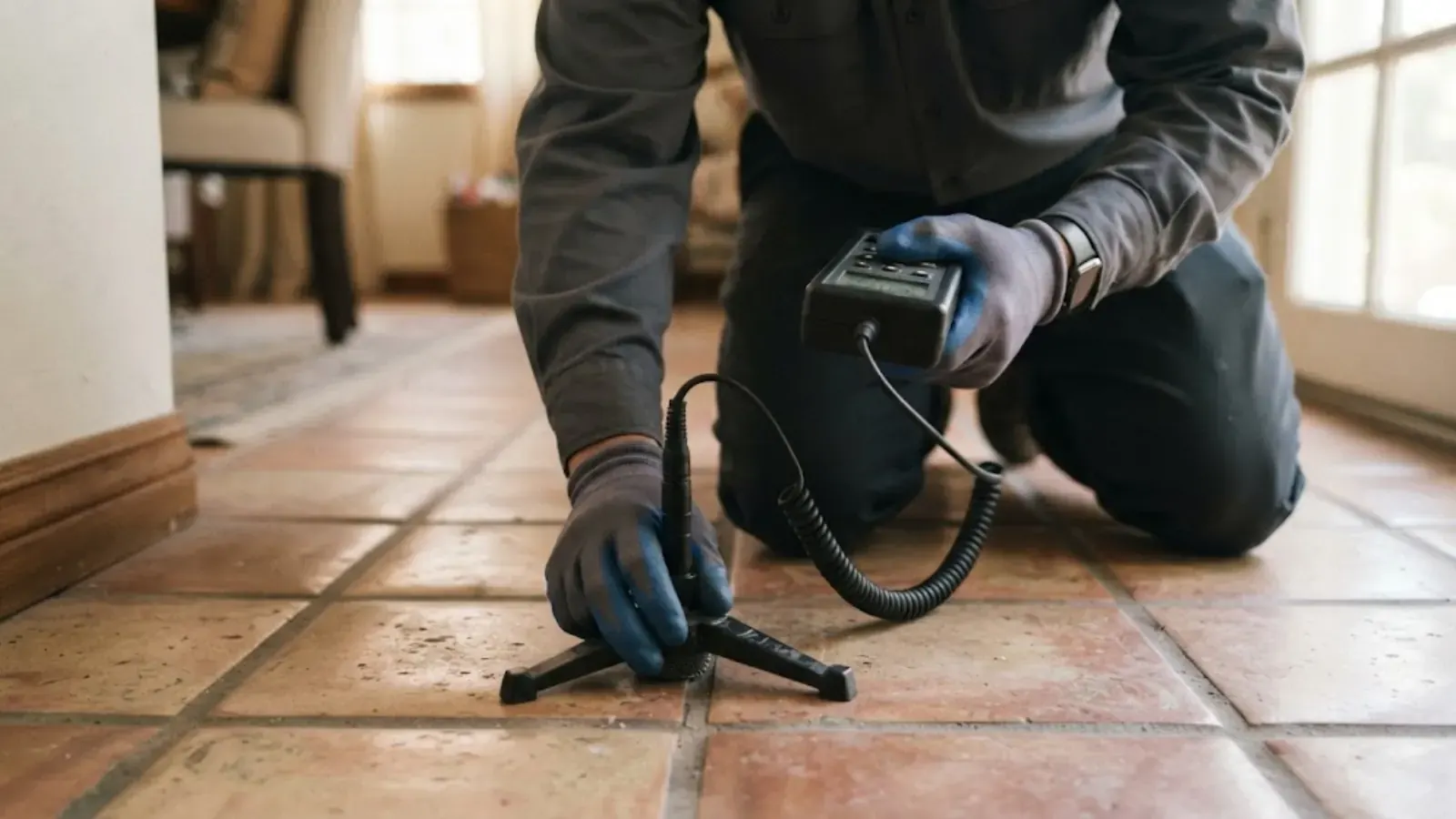
A survey is a chain of tests, and each one rules something out. We start with the meter and a pressure gauge, then use sound, heat and moisture readings to place the leak inside a small area. The aim is one small opening, not a gutted room.
| Method | What it detects | Limit |
|---|---|---|
| Meter and pressure test | Whether any water leaves the system and which section holds pressure | Proves a leak exists but not where |
| Acoustic listening with a ground microphone or contact sensor | The hiss of pressurized water escaping a pipe | Weak on plastic pipe, and traffic or running water can drown it out |
| Thermal camera | Temperature differences from hot lines or wet material behind a surface | Cold supply lines show little contrast |
| Moisture meter | Dampness in drywall, wood and subfloor | Shows where it is wet, and water can travel from its source |
| Camera on a push cable | The inside of a drain or sewer line | Does not find leaks in pressurized supply pipe |
Ceiling and wall leaks that show up far from the source
A brown ring on a ceiling or a bubbled patch of paint is water that has already traveled. It can run along a joist or down a pipe chase before it shows, so the stain is rarely right under the leak. We check supply lines to a bathroom above, drain connections, and the water heater if it sits in an upstairs closet or attic.
Not every wet wall is a plumbing leak. Roof flashing, an air handler drain and window condensation leave similar marks. We tell you plainly when the water is not ours to fix, so you can call the right trade.
Note these before we arrive
- Draw a pencil line around the stain edge and write the date beside it.
- Watch whether it grows after showers, after rain or after the dishwasher runs.
- Note any musty smell, bubbling paint or soft drywall.
- Do not poke the ceiling open, which can release a surprising amount of trapped water.
Leaks under the house or in a crawlspace
We do not assume what is under your house, because foundation types vary and we have no reliable local figure to lean on. Check your own home. A hatch in a closet floor or a small door in an exterior wall usually points to a crawlspace.
If you do have one, it is the easiest place to spot a slow supply or drain leak. We look for drips at joints, damp insulation, a wet vapor barrier and fresh mold on joists. Wear gloves and a mask, and stay out if you see standing water near wiring.
A home with no crawlspace and no basement can lose water under a concrete floor. That is a separate diagnosis, covered on our slab leak repair page.
Buried line leaks between the meter and the house
A buried leak rarely announces itself. Look for a meter that moves with the house valve closed, a soft or sunken strip of ground, a lawn patch that stays green in dry weather, or pressure that sags at the tap. Water from a failed line can also surface a long way from the break.
We confirm the leak is on the buried section by closing the house valve and watching the dial, then trace the line with a locator and listen along it. Call 811 at least three working days before any digging, as NC 811 asks homeowners to do. Locating publicly managed lines is free. Once the spot is known, water line repair covers the options.
Irrigation, pool and spa, and yard leaks
Irrigation systems
Sprinkler systems leak at valves, broken heads and buried laterals. A zone that floods one corner, a head that mists instead of sprays or weak pressure at the far end all suggest a break. We isolate the supply to the system, check the dial, then run zones one at a time while watching for pressure loss. Sprinkler heads, controllers and zone programming are normally a landscape or irrigation contractor's work.
Pool and spa lines
A pool that drops faster than evaporation explains may be leaking at the plumbing instead of the shell. A bucket test and a pressure test of the return and skimmer lines separate the two. We handle the supply and equipment-pad plumbing. Shell, liner and pump repairs belong to a pool contractor, and we will say so rather than guess.
Water at the meter box
Water in or around the meter box can come from a connection on your side, a connection on the utility side, or simply rain filling the box. Do not dig around it or adjust the meter. Lift the lid only as Cary's guidance describes and photograph what you see.
Call Cary at (919) 469-4000 if water is rising out of the box. If the dial keeps moving with your house valve closed, the leak lies between the meter and that valve.
Match what you see to the next step
| What you see | Likely cause | Next step |
|---|---|---|
| Dial moves with the house valve closed | Leak between the meter and the house | Call us and hold off digging until 811 has marked the lines |
| Dial moves only with the valve open | Leak inside, such as a fixture, pipe or toilet | Run the dye test, then book a survey |
| Brown ring on a ceiling that grows after showers | Supply or drain leak overhead | Mark the edge, pause nearby fixtures and call |
| Soggy lawn strip with no rain | Buried line or irrigation leak | Photograph it, switch irrigation off and call |
| Low pressure on the whole street | Possibly a Cary main | Ask neighbors, then call Cary at (919) 469-4000 |
What changes the price of leak detection
Detection is priced by the work needed to find the leak, and you get a clear price before work starts.
Access
An open attic or crawlspace is quick to search. Finished ceilings, tile and landscaping slow the work.
Number of tests
A meter test can settle a simple case. Buried lines add locating and listening time.
Pipe material
Plastic and metal carry sound differently, which changes the tools we need.
Size of the property
Longer runs and more zones mean more sections to isolate.
The repair afterward
Finding a leak and fixing it are separate jobs, and the fix depends on depth and pipe type.
Insurance policies often cover sudden water damage but frequently exclude slow, long-running leaks, and what they pay toward finding the leak varies. Read your policy or ask your agent before you book.
How a leak report ties into permits and insurance
Finding a leak is diagnosis. The repair that follows is governed by the 2024 North Carolina Plumbing Code, based on the 2021 International Plumbing Code (IPC), and the plumber can say whether the work needs a permit.
Keep the report. Your insurer and the Town of Cary, which provides water service to Morrisville, may both ask for it.
Call (919) 944-7281 and describe what the meter is doing. Dispatch answers at all hours.
Questions we hear
Yes. Dispatch answers after hours, on weekends and on holidays. For an active leak, close the main valve first, then call (919) 944-7281. A slow leak or a bill question can usually wait for a same-day appointment when available.
No. An ice maker refill, a softener cycle, an irrigation timer or a toilet that refills after a flush can all turn the dial. That is why the check starts with every fixture off. A dial that keeps moving after that is a real signal.
Cary bills water for Morrisville addresses. From Morrisville, use Cary's (919) 469-4000 line, which Cary lists for callers outside its town limits. Ask what it needs to see for a leak adjustment, and tell us if you want written findings from a survey.
Usually not at first. Meter, pressure, acoustic and thermal tests narrow the search to a small area, and the opening we make is sized to the pipe. Occasionally a result is unclear, and we say so instead of cutting on a guess.
Often, yes. Sound and heat tools work through drywall, floors and soil, though plastic pipe is quieter and deep lines are harder. We report how sure we are, and we may suggest a second method before any digging.
Yes, in most cases the same visit gives you a clear price for the fix. A split pipe falls under burst pipe repair, while a failed buried line is quoted as a service line job.