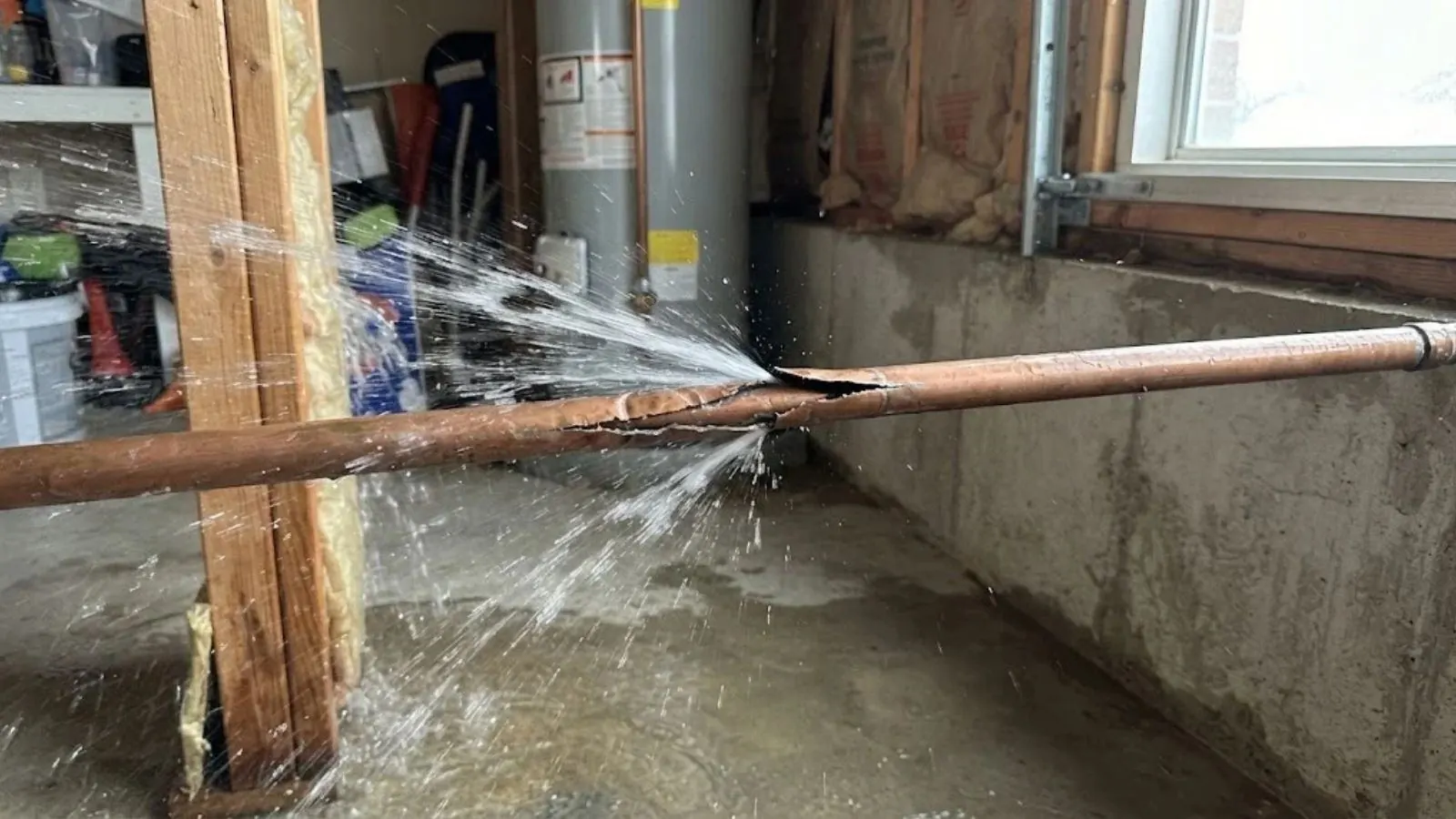
Burst pipe right now: the first ten minutes
If a pipe has burst right now
A supply line under pressure can release a lot of water in an hour. Stopping the flow comes before everything else.
Find and close the main
It is usually where the line enters the house, near the water heater or on a garage or utility wall. Turn it clockwise until it stops.
Cut power to wet areas
Flip breakers from a dry position. Do not touch outlets, cords or panels while standing in water.
Relieve pressure and contain
Open a low faucet to drain the line. Move belongings, and use towels or a wet vacuum on standing water.
Photograph, then call
Take pictures of the damage for your insurer. Call (919) 944-7281 and describe where the water is coming from.
Why supply lines burst
Water expands when it freezes, and the pipe often splits in the stretch between the ice and a closed fixture, where pressure builds. Corrosion thins the wall until a joint or elbow gives way. A nail or screw through a wall, a failed fitting and impact during renovation cause the rest.
Cold is not the only cause, and a warm-weather burst is not a mystery. We look at the split, the pipe wall around it and the fittings on both sides. The wall condition tells us whether this is one accident or the first of many.
Lessons from the long freeze of January 2018
Cary stayed at or below freezing from 2 AM on December 31, 2017 until midday on January 7, 2018, close to a full week, according to the Cary Citizen newspaper archive. Many frozen-pipe problems were reported. The article does not name Morrisville, but Cary and Morrisville share a water system and a climate.
Long freezes find the weak spots: exterior walls, garage lines, any crawlspace you may have and outdoor spigots. Know where your main shutoff is before a freeze, and check for dripping after the thaw, because many splits only show when flow returns.
Source: Cary Citizen archive, January 2018.
A pipe that is frozen but has not burst
What helps, and what does not
- Open the faucet nearest the frozen section slightly so melting water has somewhere to go.
- Warm the pipe slowly with a hair dryer, a heating pad or towels soaked in warm water.
- Never use a torch, a heat gun on high or any open flame near a pipe or wall.
- If you see a split or water appears, close the main valve at once.
- If the frozen section is inside a wall and you cannot reach it, call us instead of opening the wall.
Repair methods by pipe material
| Pipe | Common failure | Repair | Limit |
|---|---|---|---|
| Copper supply | Freeze split or pinhole at a corroded joint | Cut out the section and replace it with new copper using a press fitting or a soldered coupling | Pinholes in several spots point toward repiping, not patching |
| PEX supply | Freeze split or a failed fitting | Remove the damaged length and join with a fitting that matches the tubing system | Mixing fitting systems is not safe, so we match them |
| CPVC supply | Brittle crack at a fitting | Cut out the crack and join with CPVC couplings and solvent cement | The cement must cure before the line is pressurized |
| PVC drain | Crack from impact or ground movement | Cut out the section and install a new piece with couplings | A camera run shows whether damage continues downstream |
| Cast iron drain | Cracks, rusted-through sections or failed joints | Replace the damaged section with no-hub couplings or replace the run | Long failing runs call for a sewer line repair plan |
Pinholes, drain cracks and slow pipe leaks
Copper pipe repair
A pinhole in copper often means the pipe wall has thinned from the inside. We cut back to sound metal, replace the section and inspect the pipe on either side. If several pinholes have shown up in different rooms, a section repair buys time but does not cure the cause.
Drain pipe repair
A cracked drain leaks only when water runs through it, so the signs are damp cabinets, stained drywall below a bathroom or a sour smell. We open access, replace the failed fitting or section and test with water. For a run inside the ground, a camera shows how far the damage goes.
Pipe leak repair
A weeping joint is a small leak that gets worse. We dry the area, find the source and replace the fitting instead of wrapping it. Leak detection comes first when the drip is hidden behind a finished surface.
Cast iron drain pipe that has cracked or rusted through
Cast iron drains fail by cracking, by rusting through at the bottom of the pipe or at a joint that has worked loose. Signs include slow drains, a sewage smell, stains on a ceiling below a stack and rust flakes in the trap. We confirm the damage by looking inside the pipe.
A short failed section can be cut out and replaced. A long run with widespread wall loss is a replacement job, and we explain what we saw so you can judge it yourself.
After the water is off
Photograph every damaged surface and keep receipts for emergency work. Water that sits in drywall, insulation or carpet padding can grow mold quickly, so drying within a day or two matters. Ask your insurer what documentation it wants before you discard anything.
Replacing sections of supply or drain piping can fall under the Town of Morrisville's plumbing permit requirement for replacement work. Ask the Town of Morrisville Inspections Department at 919-463-6190 whether your repair needs one. Our work follows the 2024 North Carolina Plumbing Code.
What changes the price of burst pipe repair
A burst in an open basement wall is not the same job as one inside a finished ceiling, and you get a clear price before work starts.
Pipe material
Copper, PEX, CPVC, PVC and cast iron each need different fittings and labor.
Access
An exposed pipe is simple. A line behind tile or inside a ceiling needs careful opening.
Extent of damage
One split is a small repair. Widespread corrosion changes the plan.
Hour of the call
After-hours dispatch is a different schedule than a daytime visit.
Water cleanup
Drying and restoration are separate work from the plumbing repair.
Policies often cover sudden burst damage but not wear or slow leaks. Coverage for the pipe itself, the water damage and the access work can be written separately, so ask your insurer.
Close the main valve and call (919) 944-7281. Dispatch is staffed around the clock.
Questions we hear
Yes. Dispatch answers at night, on weekends and on holidays. Close the main valve, switch off power near water and call (919) 944-7281. We ask where the water is coming from so the right tools go on the truck.
Look where the water line enters the house, often near the water heater or on a garage or utility wall. Some homes also have a valve at the meter. Find it before you need it, and test that it turns.
Yes. We thaw it gently and check the pipe and fittings for splits once flow returns. We never use open flame, and we advise insulating or relocating lines that keep freezing.
If you plan to drain lines, yes. Switch off an electric heater at the breaker so the elements are not exposed with a low tank. For a gas heater, set the control to off or pilot per the label.
A burst is a sudden failure that floods. A leak is slower and often hidden. We locate hidden leaks through leak detection, then repair them the same way.
A clean section in sound pipe usually lasts. Repeated bursts or pinholes in several rooms are a sign that the pipe itself is failing, and we will say when repiping makes more sense.