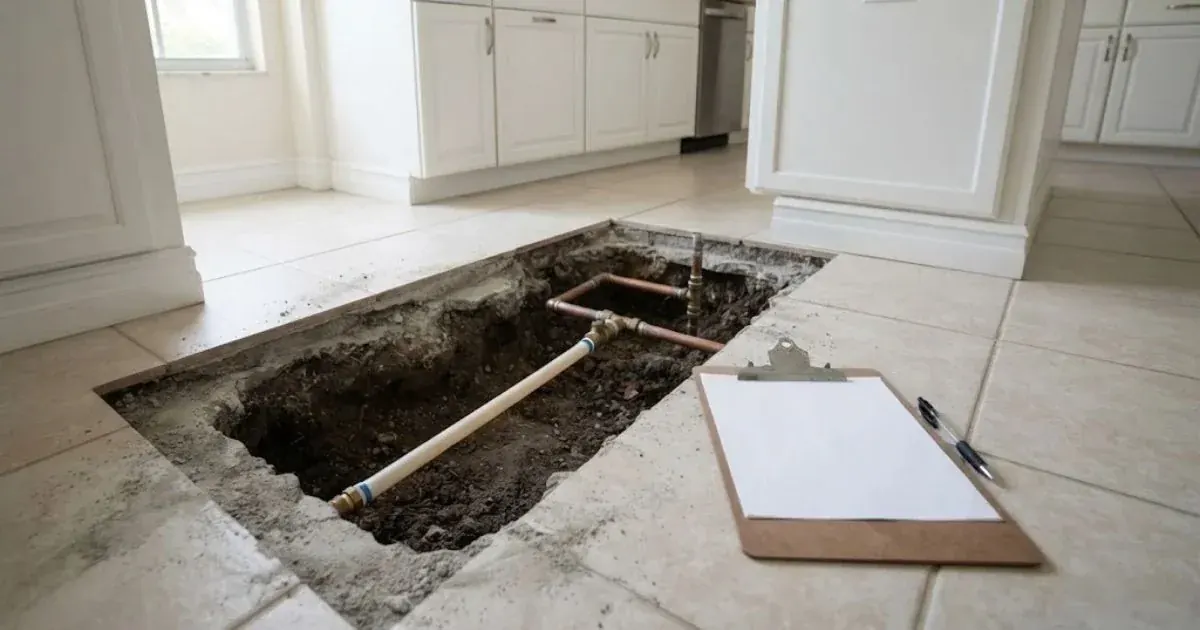
Warm floors, a hissing sound and a meter that never rests
Signs water may be leaking under a slab
- A warm patch on tile, wood or carpet that you can feel with a bare foot.
- The sound of running water at night when every fixture is off.
- A water meter dial that moves with the whole house shut down.
- Hot water that takes longer to arrive, or a water heater that seems to run constantly.
- Damp baseboards, a musty smell or a spreading stain on the flooring.
- Cracked grout, lifting tile or a floor that feels spongy.
None of these proves a slab leak on its own. A leaking water heater, a running toilet or a buried yard line can move the meter just as well. That is why we test before we quote.
Confirm it is under the floor before you pay for a dig
These checks take about fifteen minutes and give the technician a head start.
- 01
Shut every fixture off
Include the ice maker and irrigation controller, then confirm the meter indicator still moves.
- 02
Close the home main
If the indicator keeps moving, the leak is outside the house. If it stops, the loss is inside, and a slab line is one candidate.
- 03
Isolate the hot side
Close the cold inlet valve on top of the water heater. If the meter stops, the loss is on the hot side or in the heater itself.
- 04
Write down what you felt
Note which rooms have warm floor spots. A hot line leaves a warm trail, and the location helps us plan the search.
Water under the floor right now
If you suspect a slab leak tonight
Hot water pooling under flooring can lift planks and feed mold. These four moves buy time.
Close the main valve
Turn the home shutoff clockwise, then open a low faucet to relieve pressure in the lines.
Switch off the water heater
An empty tank can damage an electric element, so cut its power before you drain lines.
Protect the floor
Lift rugs, move furniture off wet areas and lay towels along door thresholds to hold water back.
Call dispatch
Call (919) 944-7281 and report the meter reading, the warm spots and what you shut off.
How we pinpoint a leak in a concrete floor
Locating comes before any cutting. We pressurize the lines, isolate hot from cold with valves and test caps, and listen across the floor with an acoustic sensor. A thermal camera maps the warm path of a hot line leak, and a pipe locator traces where the line actually runs under the concrete.
The mark we put on the floor usually covers a small area, and we confirm it with a second method before opening anything. We do not cut a slab on a guess. When tests disagree, we say so and may recommend a wider leak survey before any repair is priced.
Spot repair, reroute or repipe
| Option | What it involves | Best when | Trade-off |
|---|---|---|---|
| Spot repair | Open the concrete over the leak, cut out the bad section, couple in new pipe and patch the slab | One failed spot in an otherwise sound line | Flooring over the opening is lost, and another leak can appear later in the same line |
| Reroute | Cap the slab line and run a new line through walls or the attic to the fixtures | The slab pipe has failed more than once or is hard to reach | Drywall and paint work, plus new lines to route and support |
| Repipe | Replace the supply system, see whole-house repiping | Several leaks or a pipe material that keeps failing | The largest job, though one decision covers the whole house |
Which one fits is a diagnosis, not a default. A single pinhole in a sound line favors spot repair. A second leak in the same line is the pattern that favors a reroute. Be wary of any quote for a whole-house repipe that skips pressure testing.
What the state says about soil and foundations
The North Carolina Geological Survey says expansive shrink-swell soils occur in parts of the state, with higher occurrence in the Triassic basins and the Carolina terrane, and that even a small amount of soil expansion can damage a foundation. That page does not name Morrisville, Wake County or Durham County.
So we never blame your soil for a leak. We do note related signs such as new drywall cracks, sticking doors or a visible crack in the slab, and we pass them along so you can ask a structural engineer. A plumber cannot judge a foundation.
Permits, code and who to ask
The Town of Morrisville's plumbing permit page lists installation, extension, relocation and replacement of a plumbing system as permit work, and says minor fixture repairs that leave supply, waste and vent undisturbed may be exempt. A slab opening or a reroute is larger than a fixture repair.
Ask the Town of Morrisville Inspections Department at 919-463-6190 who pulls the permit before work begins. Work follows the 2024 North Carolina Plumbing Code, which became mandatory on July 1, 2025.
What changes the price of slab leak repair
The same leak can need very different work depending on where it sits, and you get a clear price before work starts.
Depth and access
A leak near a wall or doorway is easier to reach than one under the middle of a large room.
Floor covering
Tile, hardwood, carpet and sealed concrete each take different effort to lift and restore.
Number of leaks
One spot repair is quick. A line with several failures may point toward a reroute.
Repair method
Spot repair, reroute and repipe are three different jobs with different labor.
Pipe type and size
The material under the slab sets which couplings and tools we use.
Many policies cover sudden water damage but treat the cost of reaching the pipe, such as breaking a slab, differently. Ask your insurer what a slab leak claim includes before work starts.
Code, permits and the paperwork after a slab repair
Rerouting a pipe above the slab or replacing a section below it is regulated by the 2024 North Carolina Plumbing Code, based on the 2021 International Plumbing Code (IPC). Ask the plumber which method they propose and whether the Inspections Department at 919-463-6190 needs to see it.
Keep the leak report, the repair invoice and photos together. Your insurer may ask for them.
Call (919) 944-7281 and tell us what the dial is doing. Dispatch is staffed at all hours.
Questions we hear
Yes. Dispatch answers at night, on weekends and on holidays. Close the main valve, switch off the water heater and call (919) 944-7281. The detailed repair plan is made after the leak is located.
Look at the base of the exterior wall. A concrete edge just under the siding or brick usually means a slab. Closing documents or house plans also show the foundation type, and we will not guess it for you.
Sometimes, if you have closed the main valve and the floor is dry. A leak that keeps running under flooring does more harm each hour, so call us if you cannot isolate it.
Only after the leak is located and you have agreed to the plan. Spot repair opens a small section. A reroute avoids the slab by running new lines through walls or the attic.
Yes. Drain and sewer lines run beneath slabs, and a crack there causes damp spots and odors, not a spinning meter. A sewer camera inspection shows the inside of the pipe.
Not always. One failed spot in a healthy line is often a spot repair. Repeated failures point toward repiping, and the pressure test results make the case either way.