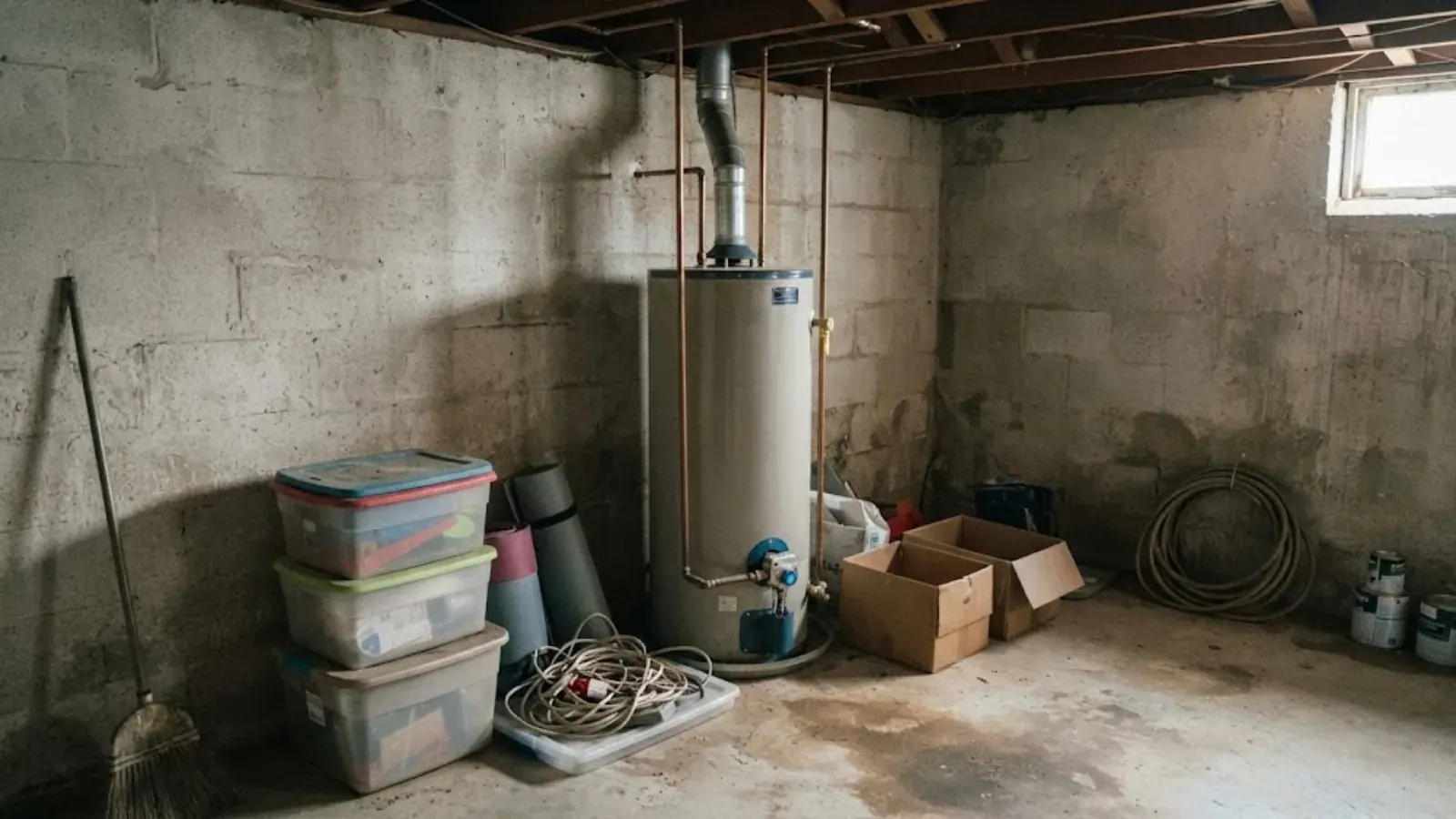
Water on the floor: is it the tank or something attached to it?
Puddles under a water heater get blamed on the tank, but many leaks start at a part bolted to it. The cold inlet and hot outlet connections, the drain valve near the bottom and the temperature and pressure relief valve can all drip long before the tank gives up. Each one has a different fix, so the first job is finding the true source.
Dry every fitting with a paper towel and watch for ten minutes. The spot that gets wet first is your leak. Water that seeps from the jacket or the bottom seam is the answer nobody wants, because a tank that has rusted through cannot be patched. In that case we shut it down and talk you through replacing the unit.
A little moisture is not always a leak. A cold tank that is refilling can sweat, and a gas heater in a cool room collects condensation on its flue. If the towel stays dry, you are looking at humidity and not a failing part.
| Where the water shows up | Likely cause | Next step |
|---|---|---|
| Drip from the pipe beside the relief valve | Pressure or temperature is climbing past the valve setting, or the valve seat is worn | Test the valve, then check house water pressure and thermal expansion before swapping anything |
| Wet threads at the top connections | A loose or corroded fitting, or a failed flex connector | Replace the connector and shutoff valve, then pressure test the joints |
| Slow drip from the drain valve | Sediment holding the seat open, or a cracked plastic valve | Fit a brass drain valve and flush the tank |
| Water pooling with every fitting dry | Corrosion through the tank wall or a split weld | Shut off the water and plan a replacement |
| Damp insulation behind an electric element cover | A failed element gasket | Replace the gasket or element. If it is dry, the tank is the leak |
Water heater leaking right now: the first ten minutes
If the tank is leaking right now
Water and power are a bad mix. These four moves limit the damage before a plumber reaches the house.
Close the cold supply valve
It is the handle on the pipe feeding the top of the tank. Turn it clockwise until it stops and the leak slows or ends.
Cut the power or gas
Flip the breaker for an electric unit from a dry spot, or turn the gas control knob to off. A heater with no water in it can burn out its elements.
Contain the water
Set a bucket under any drip, run a wet vacuum if you have one and lift boxes off the floor. Do not wade through standing water near outlets.
Call and describe it
Dial (919) 944-7281 and tell dispatch the fuel type, where the water is showing and what you have turned off.
No hot water, or only lukewarm: what fails on each type
The first question is how the heater makes its heat, because gas, electric and heat pump units fail in different places. A cold shower at six in the morning is the usual alarm. Here is how we work through each type.
Gas tank heaters
A gas tank needs a flame, a sensor that proves the flame and a gas valve that obeys. A pilot that will not stay lit often points to a worn thermocouple. Newer units use an electronic igniter and a flame sensor, and a sensor coated in soot is a classic reason for a heater that lights and then quits. We check the flue draft, the burner and the gas control valve before any part goes in.
If you smell gas at any point, leave the house and use the numbers in the local note below before you call us.
Electric tank heaters
An electric tank has an upper and a lower heating element, a thermostat for each and a high-limit cutoff with a small red reset button. Water that runs warm and then fades quickly often means a dead lower element. No heat at all can mean the upper element, the upper thermostat or a tripped breaker. We test elements with a meter for resistance and for a short to ground, with the power locked off.
Heat pump (hybrid) heaters
A hybrid unit adds a compressor, a fan and an evaporator coil on top of a tank, plus backup elements. Most calls trace back to a clogged air filter, a blocked condensate drain or a unit that has dropped into element-only mode. Sealed refrigerant work belongs to the manufacturer's service network, and we say so instead of guessing.
Gas and power contacts for Morrisville homes
Natural gas in Morrisville comes from Enbridge Gas, not Piedmont. If you smell gas near the heater, leave the building, then call Enbridge's emergency line at 1-877-776-2427, which is staffed around the clock, or call 911 from a safe distance such as a neighbor's home. Call us afterward and not before.
Electric service is Duke Energy Progress. A breaker that trips again right after you reset it is a reason to leave the heater alone and call, because the fault may be a shorted element or damaged wiring and not a simple thermostat.
Source: Town of Morrisville new residents page and Enbridge Gas North Carolina
Repairs we make, and signs that a repair is the wrong spend
Parts we replace on a tank heater
- Upper and lower heating elements and thermostats on electric tanks
- Thermocouple, igniter, flame sensor and gas control valve on gas tanks
- Temperature and pressure relief valve and its discharge pipe
- A brass drain valve in place of a failing plastic one
- Flex connectors, shutoff valves and dielectric fittings
- The anode rod, which corrodes first so the steel wall lasts longer
- The dip tube, when cold feed water is mixing at the top of the tank
- A thermal expansion tank on a closed plumbing system
Signs the tank itself is finished
- Water seeping from the tank body or the bottom seam
- Rust-colored hot water while the cold side runs clear
- A rumble or popping that returns soon after every flush
- Repeated element or thermostat failures within a short span
- A repair quote that eats a large share of the cost of a new unit
We tell you plainly when a part is cheap and the tank is sound, and when it is not. Diagnosis comes before any sale. If the tank is the problem, the replacement options come with the same clear price before work starts.
Rusty water, popping noises and a short hot supply
Noise from a tank usually means sediment. Minerals and grit settle at the bottom, water trapped under the layer flashes to steam and the tank pops and rumbles. A flush removes it, provided the drain valve still opens and closes cleanly. A valve that has sat shut for years may weep after being opened, which is a fair reason to swap it for a brass one during the visit.
Cary reports the water it sends to Morrisville as moderately soft, so scale tends to build more slowly here than in hard-water areas. Sediment still collects from the lines and from the tank itself. The water softener page explains the published numbers and when a softener is worth buying.
Rusty water from the hot tap only points at the tank, usually the anode rod or the inner wall. Rust from both taps points at the pipes. Run the cold tap for a minute to tell which.
What changes the price of a water heater repair
A repair visit is priced on what we find. You get a clear price before work starts, and these factors explain why two visits can differ.
The failed part
An element or thermostat is a small repair. A gas control valve or a heat pump component costs more, and some parts are special order.
Fuel and unit type
Gas, electric and hybrid units use different parts and different test equipment, so the labor differs.
Access to the tank
A heater in a tight closet, an attic or a crawlspace takes longer to reach than one in an open garage.
Condition of the tank
A flush, a new drain valve or an anode rod adds to a visit but can extend the life of a sound tank.
Time of the call
After-hours visits can be priced differently than daytime ones, and we state that before work starts.
Homeowner policies often cover sudden water damage from a failed heater but not wear, rust or a slow leak left unrepaired, and they may not pay for the heater itself. Photograph the damage and ask your insurance agent what your policy says.
How a repair visit goes
The order below does not change between a Tuesday noon call and a Sunday midnight one.
- 01
Make it safe
We shut off water, power and gas as needed, check for a gas odor and spilled exhaust, and protect the floor.
- 02
Find the real fault
A meter, a gas pressure gauge and a moisture meter tell us whether the problem is a part or the tank.
- 03
Quote it plainly
You hear the cause, the options and a clear price before work starts. If the tank is finished, we say so.
- 04
Repair and test
New part, a full heat-up cycle, a leak check at every fitting and a look at the relief valve discharge.
Standards and safety around a repair
Repairs follow the manufacturer's instructions and the 2024 North Carolina Plumbing Code, based on the 2021 International Plumbing Code (IPC). The temperature and pressure relief valve is a safety device and should never be capped or removed.
If you smell gas, leave first and call Enbridge Gas at 1-877-776-2427 or 911 from a safe distance.
Dispatch answers 24/7 and books same-day appointments when available.
Night, weekend and holiday failures
Heaters rarely fail at convenient times. A pilot dies on a Sunday, or a connector lets go at two in the morning. Dispatch takes those calls the same way it takes noon calls, and a plumber can often make the house safe the same night, with the full repair following in a same-day appointment when available.
Tell the dispatcher what you already shut off. If the heater is in a finished basement or above a ceiling, say so, because that changes how much water damage to expect.
Repair, replace or switch to tankless
A sound tank with one bad part is a repair. A tank that leaks from its body is a replacement, and a household that is tired of running out of hot water may want to read about a tankless unit before deciding.
Moving the heater, changing fuel or adding a heat pump unit is a different job, covered under water heater installation. If a leak seems to come from the pipes and not the tank, leak detection is the next step.
Questions we hear
That pipe carries away water when the valve opens, so a steady drip means the valve is releasing pressure or has a worn seat. Rising house water pressure and thermal expansion are common causes. Do not cap the pipe, because the valve is a safety device. We test the valve and the pressure before replacing it.
Yes. Dispatch answers 24/7, including holidays, and a licensed plumber can usually make the house safe the same night. Tell the dispatcher the fuel type, where the water is showing and what you have shut off.
Sometimes. A worn thermocouple or a dirty flame sensor is a modest repair. A pilot that blows out because of poor venting or a draft problem is a safety issue, and we check the flue and combustion air before relighting anything.
You can press the red reset button behind the upper element cover only after the breaker is off, and only once. If it trips again, a failed thermostat or a grounded element is likely. Stop and call, since resetting repeatedly can hide a shorted part.
We handle the plumbing, electrical and element side, clean the filter and condensate drain and check settings. Sealed refrigerant repairs belong to the manufacturer's authorized service, and we tell you when that is the case.
Often, yes, when the tank still has a good wall and a drain valve that works. Flushing clears sediment that causes rumbling and a short hot supply. It does not cure a leaking tank, and we will say so before charging for it.
We dispatch to south Durham and Research Triangle Park from our Morrisville base. The Durham page lists the ZIP codes we cover first and explains who to call for city main problems.