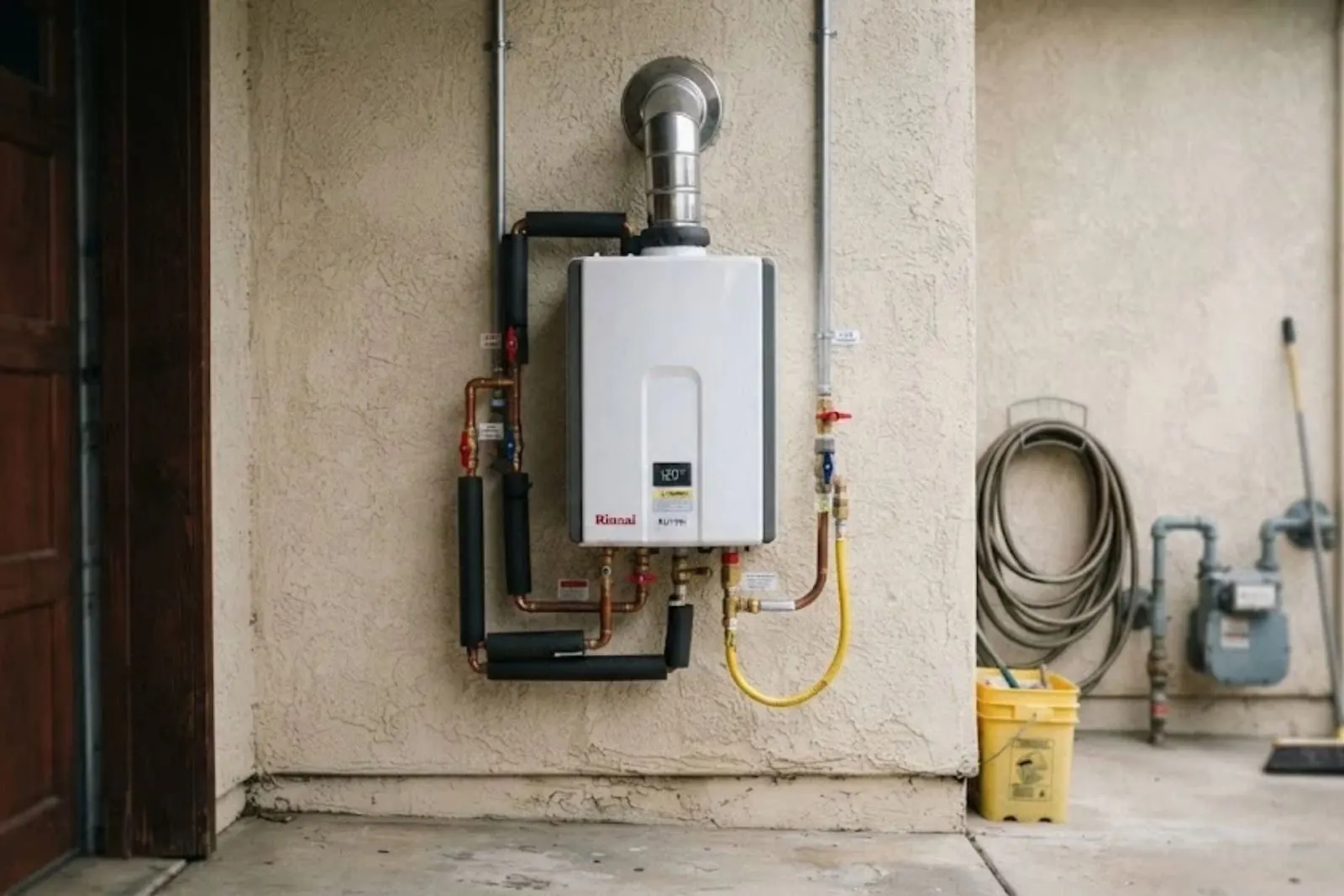
Is tankless right for your house? An honest checklist
A tankless heater warms water as it flows, so it never runs out in the middle of a shower. That benefit comes with requirements that surprise people. The two lists below sort the homes where it fits from the ones where it does not.
Tankless fits when
- The household wants endless hot water and has wall space for a unit
- A gas line of the right size can reach the unit, or the panel can feed an electric model
- The heater can vent through a wall or roof without a long, awkward run
- The family uses fixtures one or two at a time most mornings
Tankless is a poor fit when
- The gas line is small and would need replacing for a short-term saving
- The electrical panel is full and the unit would need a very large new circuit
- Many fixtures run at the same moment and the unit is sized too small
- You want the cheapest possible swap for a failed tank, since tankless costs more to install
Gas or electric: what the house must provide
| Requirement | Gas tankless | Electric tankless |
|---|---|---|
| Energy supply | A gas line sized for the unit, often larger than a tank heater needs | A dedicated circuit with a large breaker, and a panel with room |
| Venting | Sealed vent through a wall or roof | None, which makes placement easier |
| Drain | A condensate drain on condensing models | None |
| Biggest limit | Gas line size and vent length | Panel capacity and the winter cold of the incoming water |
| Yearly care | Flush, check the inlet screen and the condensate trap | Flush and check the inlet screen |
Electric tankless units often need an electrician for the circuit and a panel assessment. Gas models need gas piping and venting. We handle the plumbing and gas side and tell you when a licensed electrician needs to be involved. A larger gas run falls under gas line work.
Gas and electric suppliers in Morrisville
Natural gas in Morrisville is supplied by Enbridge Gas and electricity by Duke Energy Progress. A tankless gas unit draws far more gas at once than a tank burner, so the pipe from the meter has to carry the load. We size it by the unit's rated input and the length of the run before we quote.
If you ever smell gas near a heater, leave the building and call Enbridge at 1-877-776-2427, which is staffed around the clock, or 911 from a safe distance.
Source: Town of Morrisville new residents page and Enbridge Gas North Carolina
The cold water sandwich and the minimum flow
A tankless heater needs a minimum flow to fire. A trickle from a low-flow faucet can leave the water cold, and a quick off and on can send a slug of cold water between two hot ones. Both are design traits, not defects.
A recirculation line, a small buffer tank or a different faucet aerator can cure the worst of it. We explain which one fits before adding parts.
Condensing and non-condensing venting
Condensing models pull extra heat from the exhaust and produce acidic condensate. They use plastic vent pipe and need a drain, and many have a neutralizer. Non-condensing models run hotter and use stainless vent material specified by the manufacturer. The vent type is set by the unit, so we choose the unit first and then lay out the vent.
Vent length and the number of elbows reduce capacity, so we measure the path before quoting. A vent that must cross a finished ceiling or run past a window is a job we plan carefully with you.
Tankless flush and descaling
Minerals in the water cling to the heat exchanger over time. A flush circulates a descaling solution through the unit and clears them. It is the single most useful maintenance task on a tankless heater, and it is the one most homeowners miss.
Your manufacturer specifies the solution and the time. This is the general order of work.
- 01
Isolate the unit
Power and gas are off. The hot and cold isolation valves are closed so only the heater is in the loop.
- 02
Connect the pump
Hoses run from the service ports to a small pump and a bucket of white vinegar or a manufacturer-approved descaler.
- 03
Circulate
The solution runs through the unit for the time the manufacturer lists. Longer is not better.
- 04
Rinse and restore
The unit is flushed with clean water, the inlet screen is cleaned, the valves reopened and a test cycle run.
A heater without service valves cannot be flushed properly. We add isolation valves during a service call so the next flush takes less time.
What Cary water means for your flush schedule
The Town of Cary supplies Morrisville's water. Its 2025 testing summary lists hardness at about 30 mg/L as calcium carbonate, roughly 2 grains per gallon, which Cary classes as moderately soft. Scale builds more slowly in softer water than in hard water.
Slower does not mean never. Follow the interval in your manual, and clean the inlet screen at each service. The water softener page explains why most homes here do not need a softener.
Error codes, no ignition and other tankless repairs
Most tankless faults arrive as a code on the display. A no-ignition code can point to a gas supply problem, a dirty flame rod or a blocked vent. A flow code can mean a clogged inlet screen or a faulty flow sensor. An exhaust temperature code often means a blocked vent or a dirty heat exchanger.
We read the code, check the manual for the model and test before replacing parts. Some boards and heat exchangers are expensive, so we confirm the cause. If a unit is past repair, the installation page covers the next step.
When a tankless unit is not heating
Check the display for a code, confirm the gas valve and the power are on, and look at the inlet screen if the flow seems weak. If a code returns after a reset, call. Repeated resets on a gas unit can hide a safety problem.
What changes the price of tankless water heater service
Service, repair and installation each carry different costs. You get a clear price before work starts.
Unit model and capacity
Larger units with higher input cost more and need larger gas lines or circuits.
Gas or electric work
Gas pipe upsizing or a new electric circuit adds materials and labor.
Venting
Longer or harder vent runs add pipe and labor, and condensing units add a drain.
Flush access
Units without service valves need them added, which adds time to the first flush.
Parts and board failures
A fan, flame rod or control board has a very different cost than a cleaned screen.
Insurance does not usually cover maintenance, wear or planned upgrades. It may respond if a sudden failure caused water damage, so photograph anything wet and keep your invoices.
Gas, venting and the code edition
Tankless installs touch gas supply, venting and water piping, all governed by the 2024 North Carolina Plumbing Code, mandatory from July 1, 2025 and based on the 2021 International Plumbing Code (IPC). Gas sizing and vent routing are the details a licensed plumber confirms on site.
Enbridge Gas can discuss meter capacity at 1-877-776-2427, and the Town of Morrisville Inspections Department at 919-463-6190 can say when a permit applies.
Call with the model number and any code showing on the display.
Swapping a tank for tankless
Replacing a tank with a tankless unit is an installation job and not a swap. Gas, venting, water and drain connections all change. The installation page lists what to expect, and the repair page covers the cases where a tank only needs a part.
If you are still deciding, ask us to compare the cost of keeping the tank with the cost of converting. We give an honest answer even when it is to keep the tank.
Questions we hear
Follow the interval in your manufacturer's manual. Hard water shortens it. Cary reports its water as moderately soft, so many homes here fall on the longer end, but the inlet screen still needs regular cleaning.
Many manufacturers allow it, and some name their own descaler. Check your manual first, since the wrong solution or too much time can harm parts. We follow the manufacturer's method.
A cold slug between hot water often comes from a brief shutoff and restart, or from flow that is too low to keep the burner lit. A recirculation line or a change in fixtures can help.
Often, yes. A tankless unit draws more gas at once than a tank burner. We size the line from the unit's input and the pipe length before quoting.
It depends on what your house can supply. Gas needs a vent and a sized line. Electric needs panel capacity and a large circuit. We check both before recommending one.
We repair many common brands for plumbing, gas, venting and sensor faults. Board-level or warranty work may need the manufacturer's service network, and we tell you when that applies.
Not always. With Cary's water at about 2 grains per gallon, a regular flush and screen cleaning usually cover it. Test your own tap, and read the softener page before deciding.