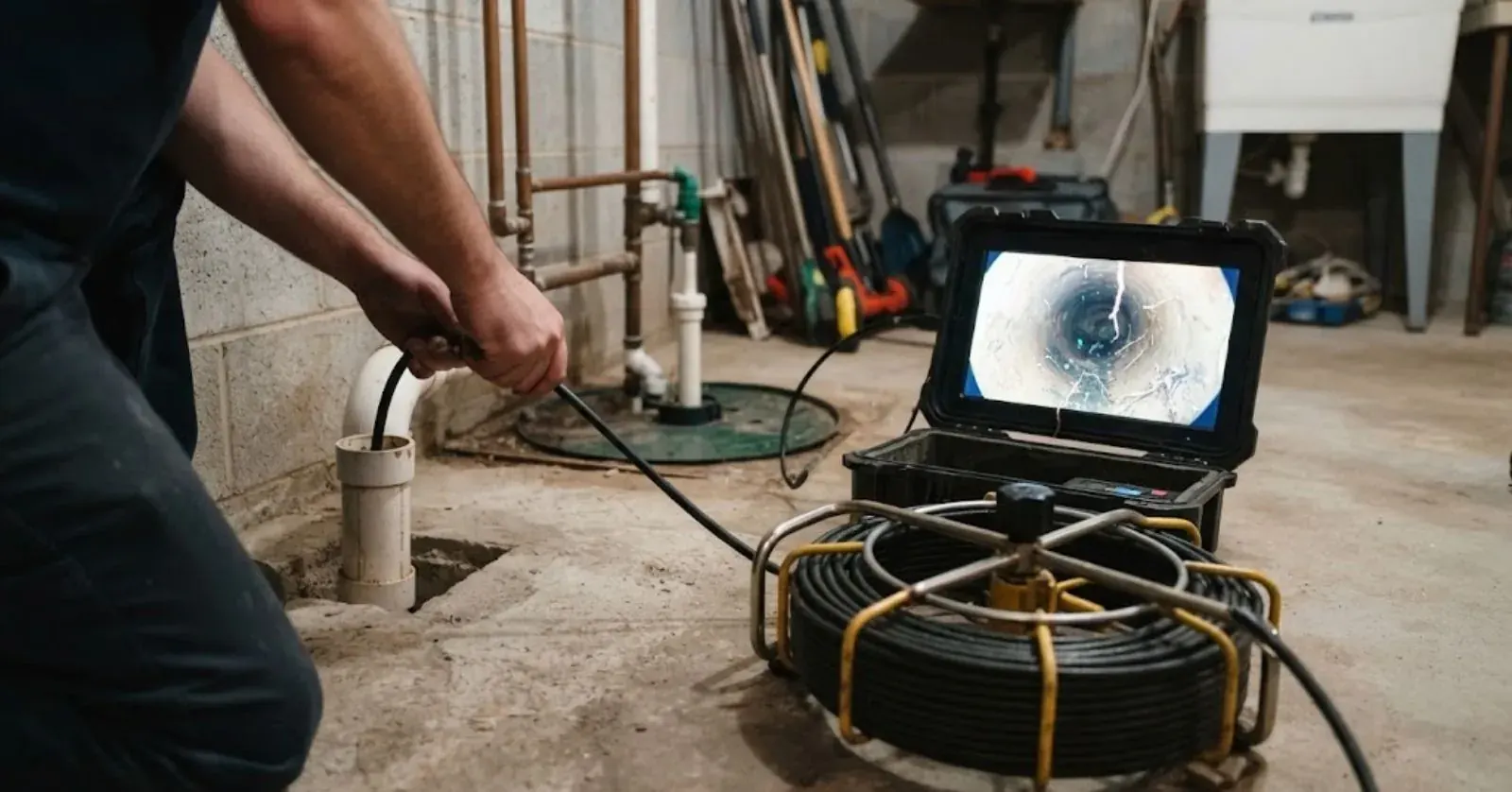
What a sewer camera inspection shows
A small waterproof camera with lights rides on a flexible push cable through a cleanout, or through the opening left by a pulled toilet. It sends live video to a monitor and can record it. We watch the pipe wall for roots, cracks, offset joints and scale, and we note where each problem sits.
The camera head also carries a small transmitter. A receiver held above ground picks up its signal, so we can mark the route and approximate depth of the lateral on the surface. That helps when you need to know where a line runs under a driveway or a patio before any digging.
| On the screen | What it usually means | Common next step |
|---|---|---|
| Fine roots at a joint | Gap at the connection letting moisture draw roots in | Root cutting or hydro jetting, then repeat checks |
| A dip where water stands | A sag, sometimes called a belly, that holds waste | Monitor it, clean it on a schedule, or repair if it clogs repeatedly |
| A longitudinal crack | Pipe stress or ground movement | Lining or spot repair, depending on length |
| Offset joint with a visible lip | Sections have shifted | Spot repair if short, replacement if there are several |
| Heavy scale or rough rust | Corroding iron pipe | Cleaning and a decision on lining or replacement |
| Clean, smooth wall | Pipe is in sound condition | Keep the recording as a baseline |
Buying a home: scope the lateral before closing
A walk-through does not show a sewer lateral. Roots, a sag or a cracked joint can sit unseen under the yard until a backup starts. A camera visit during the inspection period turns that unknown into a recording you can show a seller or a repair contractor.
Ask the seller for access to the cleanout, and ask us for the recording, not only a verbal summary. If the camera finds damage, you can negotiate a repair credit, request a repair, or walk away with facts in hand.
Morrisville ownership and the sewer: why renters and landlords care too
Morrisville's owner-occupied housing rate is 45.4 percent in the Census Bureau's 2020 to 2024 estimate, which means a bit more than half of homes are rented. A tenant who notices repeat clogs cannot order a camera visit alone, since the lateral belongs to the owner.
If you rent, report slow drains in writing to the owner or property manager. If you own a rental or are buying one, schedule the camera before you rely on the line, because a lateral problem here is the owner's cost from the cleanout to the building.
Source: U.S. Census Bureau, QuickFacts for Morrisville. Cary rule on lateral responsibility: Town of Cary.
Repeat clogs: find the cause, not just the clog
Clearing a clog treats a symptom. If the same drain slows every few weeks, the useful question is why. A camera can show a root intrusion at a joint, a sag that holds waste, grease built up on rough pipe, or a bit of a collapsed section.
If the answer is a fixable cause, drain cleaning or jetting may be all the line needs, and a damaged section points to repair. With that answer we can recommend the right fix. It may be a jetting schedule, a short repair, or no action beyond watching the line. The footage keeps the decision honest, because you see what we see.
Locating the lateral and the cleanout
If you do not know where your sewer line runs, the inspection can map it.
- 01
Find an entry point
We look for a cleanout at the edge of the property or near the house. If none exists, we may pull a toilet to feed the camera in.
- 02
Run the camera
The camera heads toward the street. We keep notes on distance, pipe material changes and defects as the cable pays out.
- 03
Mark the route
With the transmitter active, we trace the path above ground and mark it with paint or flags, along with the depth reading.
- 04
Review the footage
We show you the recording, explain what matters and what does not, and leave you with a clear list of options.
What a camera cannot tell you
Honest limits of a sewer camera visit
- It cannot see through a fully blocked pipe. We clear the line first, or the camera stops at the blockage.
- Standing water in a sag hides the pipe floor. The camera shows the water level, but not what lies underneath.
- Depth readings from the receiver are approximate, and ground conditions can shift them. A trench still needs a proper utility locate.
- Footage past your cleanout into the Town's main belongs to Cary's system. We can note what we see, but we do not repair it.
- A clean recording today is not a guarantee for next year. Roots and ground movement continue.
Reading a camera report against the code
A camera inspection records what is in the pipe. It does not by itself say whether the pipe meets the 2024 North Carolina Plumbing Code, which is based on the 2021 International Plumbing Code (IPC). Ask the plumber to describe findings in plain terms such as offset joints, root intrusion or a belly that holds water.
Keep the video file. It helps if a repair needs a permit or if you are comparing a second opinion.
Call to book a camera visit, and ask for the recording.
What changes the price of a sewer camera inspection
Inspection time follows the length of the line and how easy it is to enter.
Line length
A short lateral is quick. A long run to the street means more cable and more review time.
Entry point
An existing cleanout saves time. Pulling and resetting a toilet adds labor.
Cleaning first
A line that is partly blocked must be cleared before the camera can pass.
Locating and marking
Tracing the route above ground adds time and is worth it before any dig.
Recording and report
A saved video and notes take extra time but are the part you can use later.
Insurers generally do not pay for an inspection that is done for information. Some home warranty and service-line plans ask for camera evidence before approving a claim. You will hear a clear price before work starts.
Questions we hear
It depends on the length of the lateral, how easy it is to enter, and whether it needs cleaning first. Dispatch can give a realistic window once you describe the cleanout and the house.
Yes, the camera follows the pipe wherever it runs, as long as we can enter it and the pipe is clear. The transmitter helps mark the route above the slab.
It helps. We can show you the footage as we go and explain what matters. If you cannot be there, ask for the recording and a short written summary.
Usually yes, because a lateral problem is expensive and invisible. The recording gives you facts to negotiate with a seller or to plan repairs with a contractor.
Yes. We feed the camera in from a cleanout and trace the transmitter signal on the surface. If you have no cleanout, we may need to enter through a toilet.
Our camera works from your cleanout into your lateral. The Town of Cary handles the main and the lateral up to the cleanout. If our footage shows a problem near that line, share it with Cary.