Who clears which part of the sewer line in Morrisville
The cleanout sets the dividing line
Morrisville's sewer service comes from the Town of Cary. Cary says it clears blockages in the main sewer line and in the lateral up to the cleanout, which is a capped, vertical 4 inch pipe at the edge of your property. You are responsible for the lateral between that cleanout and your home. If there is no cleanout at the edge, you are responsible for blockages anywhere in the lateral.
Cary lists sewer blockage help on weekdays from 7 a.m. to 7 p.m. at 311 or (919) 469-4090, and after hours and holidays at (919) 469-4012. Cary's 311 line is for callers inside Cary, so from Morrisville the ten digit numbers are the safer choice. Morrisville's resident guide says Cary Public Works handles emergency sewer service.
Source: Town of Cary, sewer lateral and cleanout guidance. Morrisville A to Z guide.
| What you see at the cleanout | What it suggests | Who clears it |
|---|---|---|
| Cap removed, pipe is dry | The blockage is between the cleanout and the house | You, and we do this work |
| Cap removed, sewage stands in the pipe | The blockage is farther toward the street | Cary clears the main and the lateral up to the cleanout |
| No cleanout can be found | The lateral has no access at the edge | Under Cary's rule you are responsible for the whole lateral |
| Sewage overflowing from the cap | Line is full under pressure | Close it again, stay back and call |
Signs the main sewer line is blocked
A blocked main shows up in more than one place. The lowest drain in the house is usually first, because sewage rises to the lowest opening. A toilet that gurgles when the washing machine drains is another early sign, and so is water that lingers in a shower after the toilet flushes.
Check these before you call
- Two or more fixtures slow or backing up at once, rather than one sink.
- Gurgling from a toilet or a floor drain when another fixture drains.
- Water or sewage in the lowest tub, shower or basement-level floor drain.
- A sewer smell in the bathrooms or yard near the cleanout.
- Slow drains returning within days of a cable visit.
Finding and opening your cleanout safely
Most cleanouts are a short capped pipe near the foundation or at the property edge. Here is how to approach one.
- 01
Look for the cap
Check along the front wall of the house and near the yard edge for a round plastic or metal cap, usually 3 or 4 inches wide, flush or slightly raised.
- 02
Stand to the side
Never put your face above the cap. A full line can push sewage out the moment the cap loosens.
- 03
Loosen slowly
Use a wrench or large pliers and turn the cap a quarter turn. If sewage seeps up, tighten it again.
- 04
Note what you see
A dry pipe or standing sewage tells us, and Cary, where the blockage sits. Then close it and call.
Backup right now: protect the house while you wait
If the main line is backing up tonight
Sewage in the house is unsanitary. These steps hold the damage down.
Stop all water
Do not flush, shower, wash clothes or run the dishwasher until the line is clear.
Clear the floor
Lift rugs, bags and boxes off the wet area. Wear boots and gloves, and wash your hands afterward.
Do not use chemical openers
They do not cut through a main line blockage and they harm the people who work on the pipe afterward.
Call the 24/7 line
Dial (919) 944-7281. Dispatch answers on nights, weekends and holidays, and same-day appointments are offered when available.
How we clear a main line blockage
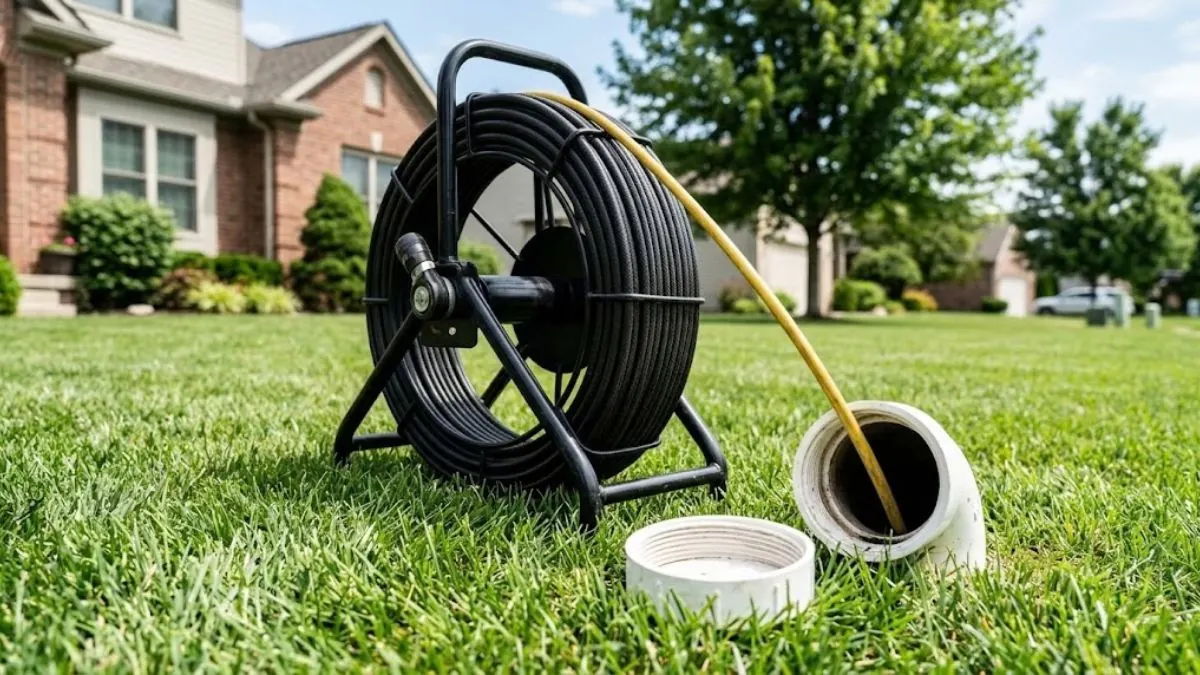
We start at the cleanout whenever there is one. A sectional or drum machine carries a cable with a cutting head through the lateral. Cutters chew roots and grease, and a retrieving head can grab a toy, rag or wipe wad. We pull back slowly and watch what comes out.
A clog at a single sink or tub is a branch-line job, and drain cleaning covers it. Only the shared main needs this larger equipment.
After the line is open, we flush with water to confirm flow and, where the blockage was bad or has happened before, we send a camera in. The picture tells us whether the cause is roots, a sag, a bad joint or a one-off item.
Sewer drain cleaning and the blockages that return
Some blockages come back within weeks. That points to roots in a joint, a belly that holds water, or grease and wipes sticking to rough pipe. When the cause is film on the wall we recommend hydro jetting, which washes the entire wall rather than punching a hole through it.
If the camera shows a crack or collapse, cleaning is only a pause. Our sewer line repair page covers lining, spot repair and replacement.
What the code and Cary say about your side of the pipe
Clearing a blockage is maintenance, not new construction, so the repair code matters less than the property line. Cary treats the lateral from the cleanout to your house as the owner's side, and any later pipe replacement falls under the 2024 North Carolina Plumbing Code, based on the 2021 International Plumbing Code (IPC).
If a camera shows damage, that is the point where permits and licensing come into play, and the Inspections Department at 919-463-6190 can say what applies.
Call the 24/7 line and tell dispatch which fixtures are affected.
What changes the price of sewer line cleaning
Clearing a main line is priced after we find the access point and the cause. Several things move the figure.
Access
A cleanout we can open is simple. A line reached through a roof vent or by pulling a toilet takes more time.
Length of the lateral
A short line is quick, while a long run needs more cable and more passes.
What the blockage is
A paper plug clears differently from a root mass or a hard grease layer.
Camera follow-up
A recording after cleaning adds time and gives you evidence of the pipe condition.
Which side of the cleanout
If the blockage proves to be in the town main, that part is the Town's to clear.
Insurance rarely covers the clearing itself. Cleanup after a sudden sewer backup is covered only with a backup endorsement on your policy, so check yours. You get a clear price before work starts.
Questions we hear
Yes. Dispatch answers 24/7. A licensed plumber can come the same day when available and will first check whether the cleanout shows the blockage on your side or toward the street.
Under Cary's published rule, the Town clears blockages in the main and in the lateral up to the cleanout at the property edge. You handle the lateral from the cleanout to the house. Confirm for your address with Cary.
Cary says the owner is responsible for blockages anywhere in the lateral when there is no cleanout at the edge. We can quote adding one, which makes later clearing and camera work simpler.
If more than one fixture is slow, if a toilet gurgles when the shower or washer drains, or if the lowest tub fills, treat it as the main. A single slow sink is usually a local clog.
You can, but the risk is real. A cable can jam or kink in a bend, a full line can spray at the cleanout, and cutting heads can scratch an old pipe. If you do try, wear eye protection and gloves and stop if it binds.
No. That rule is Cary's, and it covers addresses that Cary serves, including Morrisville. Durham homes follow the City of Durham, which lists 919-560-4344 for sewer overflows. Our Durham page explains who to call first.
If the cause was a one-off item, yes. If the line keeps closing, it is usually roots, grease or a damaged section, and a camera plus jetting or repair is the lasting answer.