Hydro jetting or a cable: which one fits your clog
| Situation | Cable machine | Hydro jetter |
|---|---|---|
| A single hair or paper clog at one fixture | Right tool, fast and low risk | More than the job needs |
| Grease coating the full pipe wall | Punches a hole, leaves the coating | Strips the coating from the whole circumference |
| Tree roots entering through joints | Chops a channel through the middle | Root cutting nozzle clears the roots and flushes the pieces out |
| The same drain clogs every few weeks | Gives temporary relief | Resets the pipe to bare wall so you can watch how long it stays open |
| A pipe the camera shows cracked or collapsed | Can snag and make it worse | Not used until the pipe is repaired |
What the jetter actually does
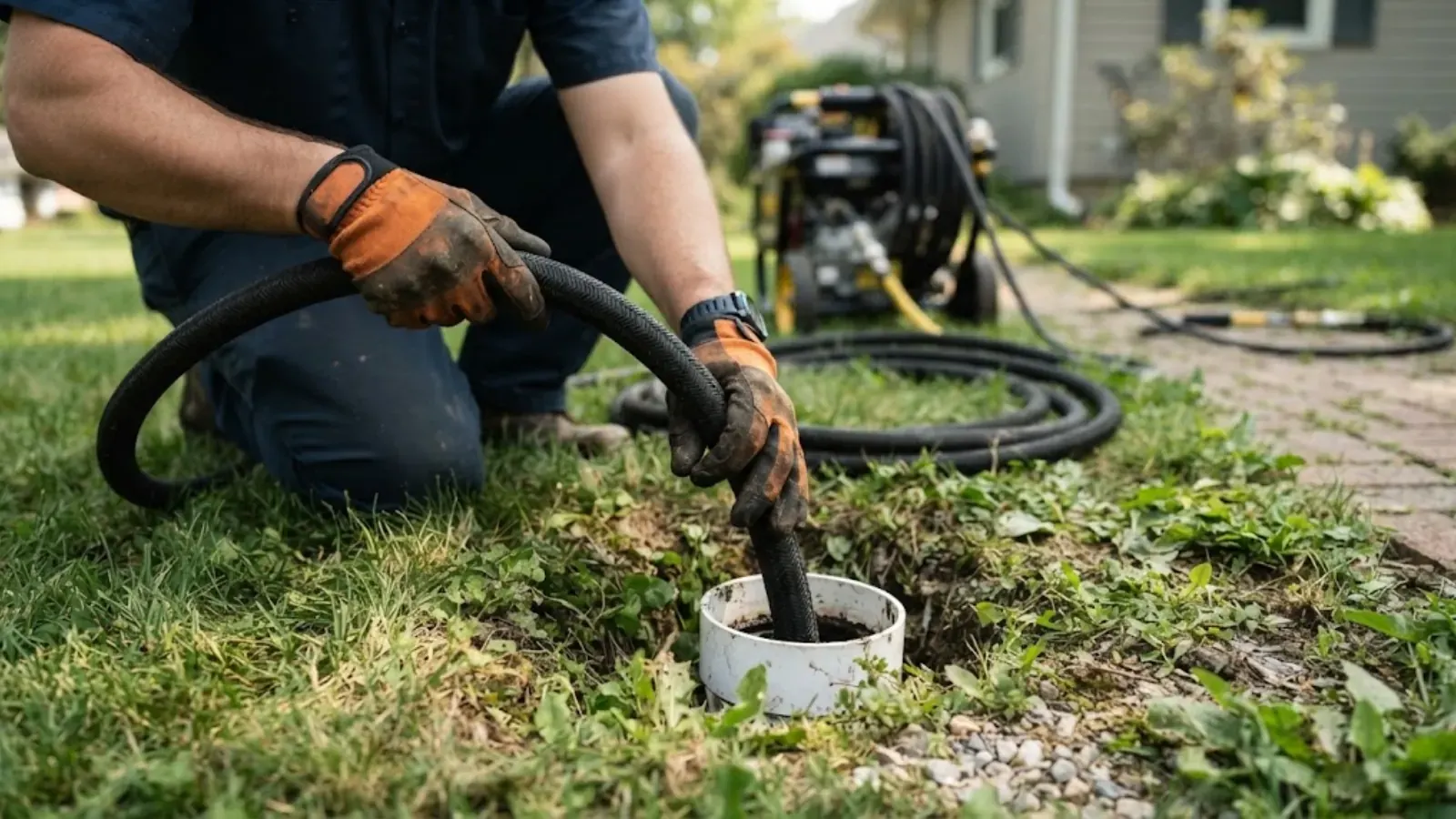
A pump unit feeds water at high pressure through a flexible hose to a nozzle. Jets pointed backward pull the hose down the pipe like a tow line, while forward jets break up the blockage ahead. A rotating head cuts roots.
You can think of it as pressure washing the inside of the pipe. A cable pokes a hole through the middle of a clog, but the jetter cleans the walls, and that is what stops a pipe from narrowing again.
Roots, grease and repeat clogs: when jetting is the right call
Roots find the small gap at a joint, then grow into a mat of hair-fine strands that catches everything flushed past it. A cable cuts the strands in the middle and leaves the mat in the pipe wall. A root cutting nozzle on a jetter trims them back to the joint, and the water carries the cuttings out.
Roots return unless the joint is sealed, so we say so up front. Jetting resets the pipe and buys time. A camera run after the jetting shows whether the entry point is a small gap, a crack or a failed joint, and that decides if you need repair at all.
Grease is the other big reason. Kitchen fat that reaches the main drain hardens into a rough layer that holds soap and wipes. It looks like a clog but behaves like a slow narrowing, which is why the same drain keeps slowing after every cable visit.
Sewer gas smell with a drain that looks fine
A sour or egg-like smell near a drain does not always mean a dry trap. Film and debris on the wall of the main drain can hold waste and release odor each time a fixture empties. If you have already refilled the trap and the vent is intact, jetting the line is a reasonable next step.
We look at the line first. A smell that comes with a gurgle suggests a partial blockage, while one that follows a plumbing change suggests a vent problem. Jetting only helps the first kind, and a camera tells us which one you have.
Backup tonight: the steps before the jetter arrives
If the main drain is backing up right now
Sewage in a tub or floor drain is unsanitary and spreads fast. Do these before we get there.
Stop all water use
Close the washer, dishwasher and showers. Even a flushed toilet adds water to a pipe that cannot take it.
Keep people out
Move children and pets away from the wet room and wear boots and gloves if you must walk through it.
Do not open the cleanout alone
A full line can surge out when the cap comes off. Let us do it, or see our sewer line cleaning page for what to check first.
Call the 24/7 line
Dial (919) 944-7281 and say how many fixtures are affected. After-hours calls are answered the same way daytime ones are.
What happens before the nozzle goes into your pipe
Jetting is a precise tool and we do not start it blind.
- 01
Camera the line
A camera head on a push cable runs through the cleanout or a pulled toilet. It shows the pipe material, the blockage and any cracks or sags.
- 02
Choose the nozzle
A smooth penetrating nozzle handles soft blockages, a rotating root cutter handles roots, and a scale-removing head works on hardened deposits.
- 03
Jet from the cleanout
The hose enters at the cleanout and runs toward the blockage. We work forward, then pull back slowly so the debris flows out ahead of the water.
- 04
Re-camera and test
A second camera pass confirms the wall is clean and shows what the pipe looks like now. Then we run water at the fixtures and check for full flow.
When we will not jet your line
Honest limits of the method
- A pipe the camera shows collapsed, badly offset or cracked open. High pressure can widen the damage and push debris into the soil. That line goes to repair first.
- A drain with no cleanout and no safe access. We would have to pull a toilet to reach it, and we will tell you if the setup makes that unwise.
- A fixture drain too small or too fragile for the hose. A cable or a different tool is used instead.
- A blockage out in the town sewer main past your cleanout. That stretch is not ours to clear, and we will say so before charging for the visit.
The cleanout is the line between your pipe and the town's
Cary, which serves Morrisville's sewer, describes the cleanout as a capped vertical 4 inch pipe at the edge of the property. Cary clears blockages in the main and in the lateral up to that cleanout. From there to the house the lateral is the owner's responsibility, and with no cleanout at the edge the owner is responsible for the whole lateral.
That is why we start every jetting job at the cleanout. If the hose finds the blockage on your side, we clear it. If water stands in the cleanout and the clog is farther toward the street, we stop and point you to Cary's sewer blockage line, listed on our sewer line cleaning page.
Source: Town of Cary, sewer lateral and cleanout guidance.
Where hydro jetting fits in code and safety terms
Hydro jetting is a cleaning method, not a repair, and a camera should confirm the pipe is sound first. Any pipe replacement that follows falls under the 2024 North Carolina Plumbing Code, based on the 2021 International Plumbing Code (IPC).
Do not use a rental jetter on old or cracked pipe. The pressure can turn a small crack into a collapse.
Call and ask for a camera check and a jetting plan for the line.
What changes the price of hydro jetting
Jetting is priced by the job, not by the hour on the phone. These are the things that move the total.
Pipe diameter and length
A short run of 3 inch drain is a different job from a long 4 inch lateral, because it needs more hose, time and water.
What is in the pipe
Soft grease washes out quickly. Dense roots and hard scale need slower work and often more than one pass.
Access
A cleanout at the edge of the property is quick. If we have to pull a toilet or set up through a roof vent, it takes longer.
Camera work
A pre-jet and post-jet camera pass adds time but keeps us from jetting a damaged pipe.
Follow-up
If the camera finds a root entry point, the next step may be repair, which is priced separately.
Insurance generally does not pay to jet a pipe for roots or grease because that is maintenance. Damage from a sudden backup is covered only if your policy has a sewer or drain backup endorsement. You will get a clear price before work starts.
Questions we hear
Yes. Dispatch answers 24/7 and sends a licensed plumber with a jetter when a main line is backing up. We ask a few questions first, because a cable is quicker for a single fixture and we would rather bring the right tool the first time.
On sound pipe it does not, because the pressure is set for the pipe size and material. On a cracked, thin or offset pipe it can. That is why we put a camera in first and do not jet lines that look damaged.
No. It cuts roots back to the pipe wall and washes them out, but roots regrow if the joint stays open. A camera after the job shows whether the gap is small enough to live with or needs repair.
Sometimes. The jetter can wash debris away from a cable head, but a stuck cable can mean a root mass, a broken pipe or a bend. We camera first, then decide whether to pull, jet or open the pipe.
There is no honest schedule that fits every house. A line with active roots may need attention yearly, while a clean PVC lateral may never need it. Camera findings after the first job set the interval.
If the smell comes from film and waste caught on the main drain wall, yes. If the cause is a dry trap, a loose cleanout cap or a vent problem, jetting will not help, and we check those first.