The short answer on time, and why the manual wins
One widely read how-to from a home building magazine calls for 4 gallons of undiluted white vinegar circulated for at least 60 minutes, followed by a cold water rinse. That is a good planning figure. It is not a rule for every model.
Tankless units differ in heat exchanger design, internal volume and materials. Your owner's manual may give a different circulation time or a different descaler. Look in the maintenance section before you buy any vinegar.
| Item | Common guide figure | What to do |
|---|---|---|
| Vinegar volume | About 4 gallons of undiluted white vinegar | Use the volume your manual states |
| Circulation time | At least 60 minutes | Match your manual, never shorten it for convenience |
| Rinse | Cold water until the smell is gone | Flush well, then clean the inlet filter |
| Flush frequency | Annual is common advice | Follow the manual interval, adjust for your water |
Morrisville water: moderately soft, so what does that change?
What Cary reports about hardness in Morrisville water
Cary's 2025 drinking water testing summary for the Cary and Apex water treatment facility lists total hardness at 30 ppm as calcium carbonate, within a range of 23 to 37. In grains per gallon the same report shows 2, within a range of 1 to 2. Cary classes that water as moderately soft. The report's glossary defines ppm as the same as mg/L.
Cary also serves Morrisville, so this is the supply your heater sees. In practical terms, scale forms slowly in soft water, which means the manual's schedule is a ceiling for how long you can go, not a reason to flush early. The figure is a lab average, though, and your own pipes, a long run of hot water at high temperature or a water softener or filter change can all shift what your heat exchanger sees.
Source: Town of Cary 2025 Drinking Water Detailed Report. Water quality questions go to the Cary lab at (919) 362-5507.
That is the honest link between our water and your schedule. Soft water slows scale, so a long stretch between flushes is plausible. Your heater itself will tell you when it needs help.
Signs your tankless heater needs descaling sooner
Symptoms worth checking
- Hot water temperature that swings or runs lukewarm at normal flow.
- An error code that your manual links to scale, flow or heat exchanger problems.
- A louder rumble or kettling noise when the burner fires.
- Lower hot water flow at the fixture even though the cold side is normal.
- A clogged inlet screen with white or tan particles after you remove it.
None of these prove scale. A kinked supply, a failing flow sensor or a blocked vent can show the same symptoms. A technician can read the error history and test the unit before anything is flushed, and our tankless water heater service page explains what that visit covers.
What you need before you start
A flush needs service valves, or isolation valves with service ports, on the hot and cold lines. Without them you cannot connect hoses to the unit. Many installers fit these during the original install, but older installs may lack them, and adding them is a plumber's job.
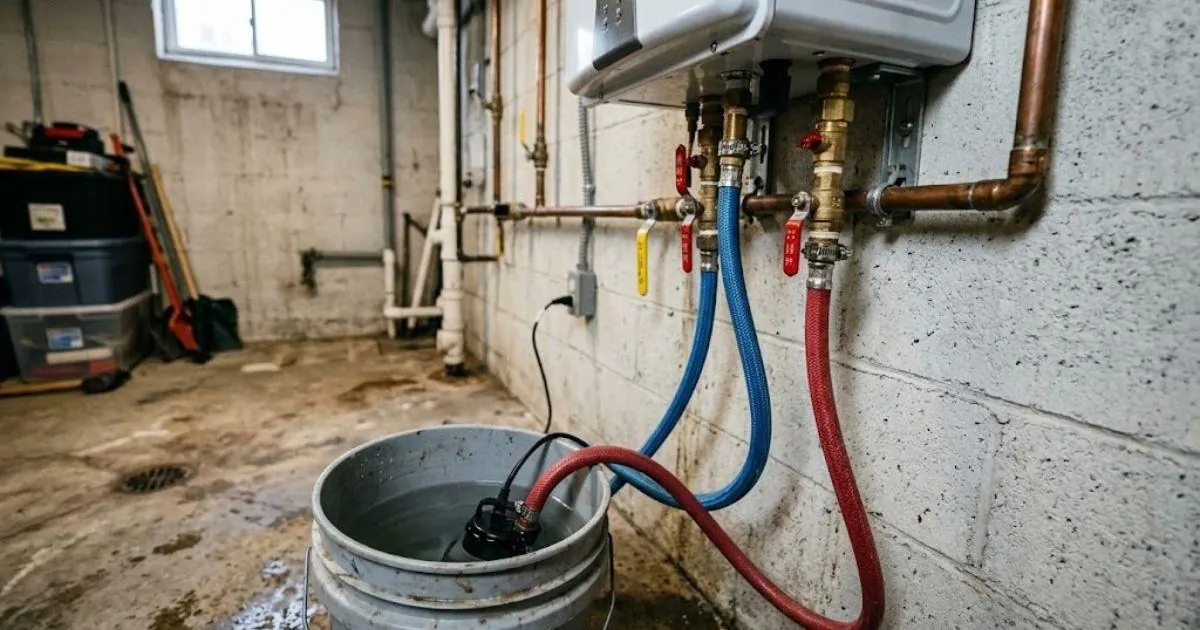
Gather a small submersible pump, two washing machine style hoses, a clean 5 gallon bucket, white vinegar and a pair of safety glasses. Check the manual for a gas model's shutoff steps and for any limit on vinegar contact with seals.
The flush, step by step
Read your manual first. This is the common sequence, not a replacement for it.
- 01
Power down and close the valves
Unplug the unit or switch the breaker off, and for gas models close the gas shutoff. Close the hot and cold service valves.
- 02
Hook up the pump and hoses
Connect one hose from the pump to the cold service port and another from the hot service port back to the bucket. Pour in the vinegar.
- 03
Circulate for the manual time
Run the pump and watch the bucket. Keep the vinegar moving for the time your manual gives, often about an hour in published guides.
- 04
Rinse and restore
Drain the vinegar, flush with cold water, clean the inlet filter screen, close the ports and reopen the valves. Bleed air at a hot tap before you restart the heater.
How often to flush with soft water
There is no single interval that suits every home. The manual gives a baseline. A home on soft water, like Morrisville's Cary supply, may see mild scale and can usually follow that baseline without shortening it. A home with a water softener, a filtration system or a very high temperature setting should look at the manual and talk to a technician.
A simple habit is to clean the inlet filter on its own at a regular interval, since it catches loose deposits. Then flush on the manual schedule, or sooner if the symptoms above appear.
Follow the manual and the code
Descaling steps come from the manufacturer's manual, which always overrides general advice. Any new valves or piping added for flushing fall under the 2024 North Carolina Plumbing Code, based on the 2021 International Plumbing Code (IPC).
If the unit throws an error code afterward, stop and call a licensed plumber.
Call (919) 944-7281 and a licensed plumber can flush, inspect and test your tankless heater.
Do you need a softener because of this?
With about 2 grains per gallon in the supply, most households do not need a softener to protect a tankless heater. Some homes add one for comfort, such as less soap scum or spotting on glass. Our water softener and filtration page covers when it makes sense.
If you want proof for your own tap, ask Cary for its current testing summary and compare it with the number on your heater's maintenance chart. For Durham addresses, the Durham page explains that city's separate water source, which is not Cary.
Questions about this topic
Published guides often say about 60 minutes of circulation. Your manufacturer's manual is the rule, so use its time and its volume if they differ.
Many manuals allow it, and some name a branded descaler instead. Check the maintenance section of your manual, because using the wrong product can affect your warranty.
Cary's 2025 testing summary lists hardness at about 30 mg/L as calcium carbonate, or about 2 grains per gallon, which Cary classes as moderately soft. Cary supplies Morrisville.
No. Soft water slows scale but does not stop it, and sediment can still collect in the inlet filter. Follow the manual interval and check the signs listed above.
A scaled heat exchanger is one cause, but flow sensor faults, gas supply problems and blocked vents also trigger codes. Look the code up in your manual and call a technician if it returns.
Not safely. Without isolation valves with service ports there is no clean way to circulate vinegar. A licensed plumber can add the valves and then run the flush.