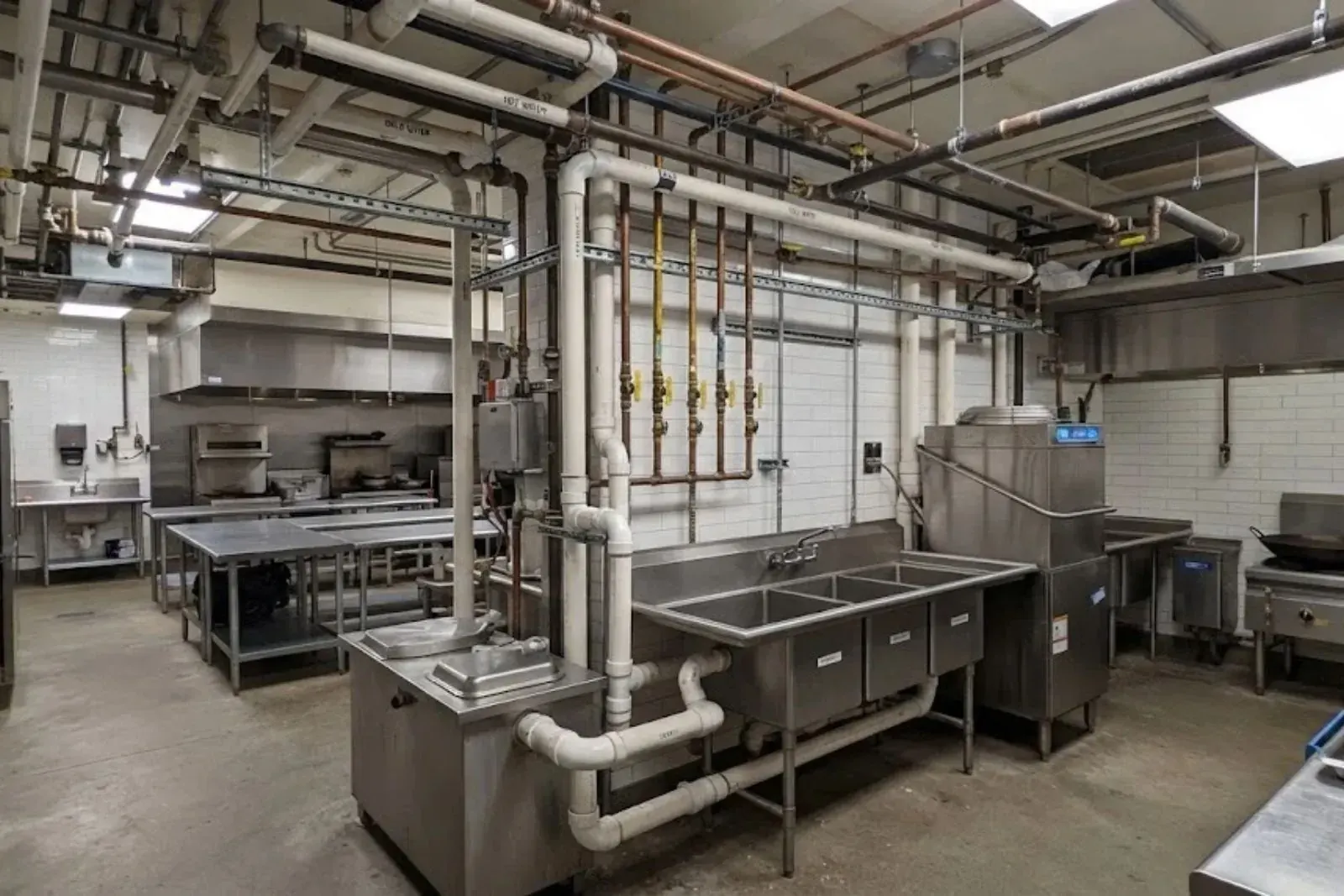
Water or sewage in an occupied building
If a business has a leak or backup right now
These steps protect people first and inventory second.
Move people out of wet areas
Keep staff and customers away from standing water, especially near electrical equipment. Block off the area clearly.
Find the shutoff
Locate the main valve or the fixture stop. A suite shutoff may exist separately from the building main, so ask the property manager.
Do not use the affected drains
If sewage is backing up, stop using sinks, toilets and floor drains downstream until the line is cleared.
Call and document
Dial (919) 944-7281, then photograph the damage and note the time. Your landlord or insurer will ask for both.
Where our commercial work fits
We work on small commercial buildings, restaurants, offices, retail units and multi-tenant properties. Much of the work is the same as residential plumbing at a larger scale, with more fixtures, more people depending on them and more people to coordinate with.
We are honest about limits. We do not design fire sprinkler systems, we do not service large industrial process piping, and we do not take on work that needs a specialty license we do not hold. If a job belongs to another trade, we say so on the phone.
| Problem | Likely source | What we do |
|---|---|---|
| Restroom toilet or urinal will not flush | Failed flush valve, supply stop or blockage | Repair the flushometer or clear the line |
| Floor drain gurgles or smells | Dry trap, blocked branch or grease buildup | Prime the trap, cable or jet the line |
| Kitchen drains slow in the whole building | Grease in the building drain or a full interceptor | Jet the line, pump the interceptor |
| Water meter spins when the building is closed | A hidden leak in supply piping | Isolate sections, then survey |
| Backflow test is due | Annual or periodic program requirement | Test the assembly and repair if it fails |
| Water stain on a lower ceiling | Leaking line from the unit above | Locate the source before opening the ceiling |
Floor drains and drain lines
Commercial floor drains are easy to forget. A trap that dries out lets sewer gas up into the room, and a clogged branch can back up into a mop sink or a restroom. We clear them with a cable or with hydro jetting when grease or scale is the cause.
A camera is the next step if the same drain keeps clogging. It shows whether the problem is grease, a bellied line or something in the pipe, and our sewer inspection page explains what a camera visit involves.
Backflow testing, honestly
A backflow preventer is a valve assembly that keeps water from flowing backward into the building supply. It sits on irrigation, fire lines, boilers and some commercial supply lines. Over time its internal check valves wear, and a failed assembly can let used water back into the clean side.
Many water systems require periodic testing, and results usually go to the utility. We do not quote a schedule from memory because the requirement depends on the utility and the device. Ask the water utility serving your address, which for Morrisville is the Town of Cary, what testing it asks for and who is accepted to test. Durham addresses answer to Durham's Cross Connection Control Department, which issues its own permit for backflow installs.
A test is simple. The tester attaches a gauge set, closes the shutoffs in sequence and records pressure readings across each check valve. A passing assembly is documented. A failing one gets new seats or rubber parts, or a replacement, and is retested.
Grease trap and interceptor cleaning
Fats, oils and grease and the Cary sewer
Morrisville sewage flows into the Town of Cary system, and Cary runs a fats, oils and grease control program. Its pretreatment staff are the people to ask which rules apply to a food business at your address, because requirements differ between a small cafe and a full-service restaurant.
The only Cary number we can point to is the Utility Pretreatment Program Supervisor at (919) 319-4564, which Cary lists for apartment and townhome managers asking about collection events. Call it, say you are in Morrisville, and ask who handles commercial kitchens. Keep your pump-out records so you can show them if asked.
Source: Town of Cary, fats, oils and grease control
A grease trap or interceptor catches fat before it reaches the sewer. Cleaning means pumping out the contents, scraping the walls, checking the baffles and inspecting the lid gasket. Waiting too long makes a full unit pass grease into the building drain, which leads to the slow kitchen drains described above.
We can clean and inspect small under-sink traps and help with larger interceptor service, and we are straightforward about hauling. Larger in-ground tanks usually need a pump truck and a licensed hauler, and we will tell you if the job needs one.
Codes and testing for business plumbing
Commercial work is built to the 2024 North Carolina Plumbing Code, which rests on the 2021 International Plumbing Code (IPC) and has been mandatory since July 1, 2025. Backflow assemblies and grease management carry their own local rules, and we do not assume a schedule or a requirement for your building.
Ask the Town of Morrisville Inspections Department at 919-463-6190 what your occupancy requires, and ask Cary who handles commercial kitchens in your area.
Call our 24/7 line. Give us the address, the unit and a contact on site.
Storm drains and drainage on the property
Storm drains are not sewers
A storm drain carries rainwater to creeks and not to a treatment plant. Rainfall at Raleigh-Durham airport runs about 46 inches a year (NWS RDU 1991-2020 daily normals), so parking lots and roof leaders get a lot of work. Leaves, mulch and silt settle in catch basins and slow the flow.
We clear private catch basins, area drains and downspout lines on a property. Public storm drains belong to the town. To report dumping into a storm drain or stream, the Town of Morrisville Stormwater hotline is 919-463-SOAK (7025). Never wash grease, paint or cleaning water into a storm drain.
Source: Town of Morrisville, stormwater resources
Commercial leak detection
A building that loses water without anyone noticing shows it on the meter and the bill. We start by isolating zones with the building's own valves, then use acoustic listening gear, a camera and a pressure test on suspect lines to narrow the source. Details on the tools are on our leak detection page.
We keep our promises small. Some leaks can be located precisely and some can only be narrowed to a section of slab or wall, and we say which one before any opening is cut.
For landlords and property managers
Census data puts owner occupancy in Morrisville at about 45 percent, so more than half of households rent. If you manage properties here, you probably handle a steady stream of work orders. Clear work orders help us arrive prepared.
Send the unit address, the access contact, the symptom in plain words and a photo if you have one. State whether the tenant should be present, and whether the work needs owner approval before we start. See the landlord questions below for who pays for what.
What changes the price of commercial plumbing work
We quote a clear price before work starts. Typical factors:
Scope and building size
A single restroom stall is different from a floor of fixtures.
Access and hours
Work in an occupied kitchen or after closing changes scheduling and labor.
Equipment
Jetting units, cameras, pumps and test gauges are used as the job demands.
Code or utility requirements
Test reports, permits and inspection visits add steps.
Condition of piping
Old or corroded pipe can turn a simple repair into a larger one.
Commercial property insurance often covers sudden water damage but not wear, and tenants and landlords can have different policies. Ask both.
Questions we hear
Yes. Dispatch answers 24/7. Close the nearest shutoff, keep people clear of water and call (919) 944-7281, and a licensed plumber can visit the same day when available.
That depends on the lease. In general, building systems like supply lines and main drains fall to the owner, and fixture damage caused by a tenant may not. We invoice whoever authorizes the work and can give an itemized report for the other party.
Cary's rule is that the utility clears the main and the lateral up to the cleanout at the edge of the property, and the owner is responsible for the rest. If there is no cleanout, the owner is responsible for the whole lateral.
The requirement comes from the water utility and the device type, so ask the utility serving the address. We can test and repair assemblies once you know what is required.
Yes. Send addresses, access details and approval limits, and we schedule visits unit by unit. We do not hold keys unless you arrange it in writing.
We clean and inspect smaller traps and help with interceptor service. Large in-ground tanks need a hauler, and we say so on the first call.
Often yes. A dry trap is primed with water, and a clogged branch is cleared with a cable or a jet. A camera helps if the smell returns.