Water is rising in the pit or on the floor right now
While the pit is flooding
Most of the damage happens in the first hour. These steps keep you safe and buy time.
Check power from a dry spot
Look at the outlet, the GFCI reset button and the breaker, but only if you can reach them without standing in water.
Never touch a wet cord
Water and a live cord can kill. If water reaches outlets or the panel, turn the main breaker off from a dry spot or leave the house and call.
Hold the water back
A bucket and a wet vacuum rated for water will slow things down. Lift boxes and furniture onto blocks or up the stairs.
Call dispatch
Dial (919) 944-7281 and say whether the pit is full, whether the pump hums or stays silent and whether the water smells like sewage.
How a sump pump works and why it fails
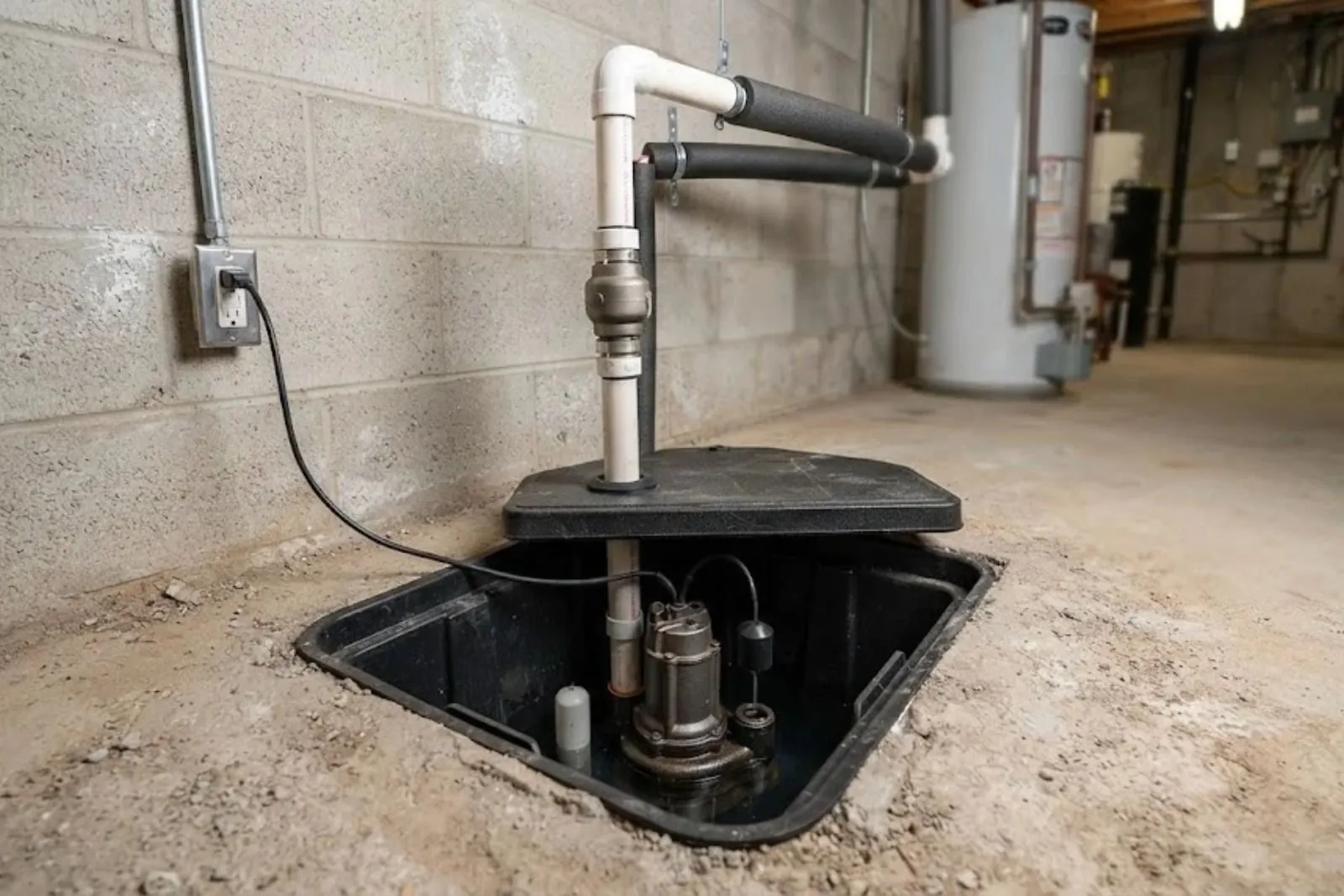
A sump pump sits in a pit, called a basin, dug below the floor level where water collects. When rising water lifts a float switch, the pump starts and pushes water up a discharge pipe, usually 1 1/2 or 2 inches wide, through a check valve and outside. The check valve keeps pumped water from sliding back into the pit.
Most failures are mechanical. A float jams against the basin wall, a switch burns out, grit seizes the impeller or a check valve fails and the pump cycles again and again. A pump that runs nonstop without lowering the water may be undersized, or its discharge may be blocked by ice or debris.
| What you notice | Likely cause | What we check first |
|---|---|---|
| Motor hums but no water moves | Seized impeller or a clogged intake | Pull the pump, clear the intake and test the motor. |
| Pump starts and stops every few seconds | Failed check valve or a float set too tight | Test the valve and reset the float travel. |
| Pit fills and the pump never starts | Stuck float, tripped GFCI or a dead motor | Power first, then the float, then the motor. |
| Pump runs constantly in dry weather | High groundwater, an undersized pump or a leak into the pit | A water meter test to rule out a plumbing leak. |
| Sewage smell from the pit or an alarm sounds | Sewage ejector fault, or a waste line tied into the wrong basin | Stop using fixtures and treat the water as sewage. |
Does a sump pit even apply to your house?
We cannot tell from town records what kind of foundation your house has, and in this area they differ. Some homes have a full basement, some have a crawlspace and some sit on a slab. A pump only helps where there is a pit, and a pit usually shows up in a basement. Crawlspace pits exist too, so ask your seller or look for a lidded basin in the floor.
If you have no pit and you see water, the fix may be a downspout extension, a grading change or a drain and pit installed for you. For a crawlspace, use a flashlight to look for standing water, dark soil or a wet vapor barrier. Our basement waterproofing page covers the drainage side in more depth.
What the rain and soil records say
Adding up the National Weather Service daily normals for RDU gives about 46 inches of rain a year for 1991 to 2020. Wake County's hazard mitigation plan, adopted in October 2024, also lists flood events attributed to Morrisville. Neither fact says your lot floods, but both say to test your pump before a wet season and not during a storm.
The North Carolina Geological Survey says shrink-swell clay occurs in the state, more often in the Triassic basins and the Carolina terrane, and that a small amount of soil expansion can damage a foundation. That does not tell you what is under your lot. It does mean new cracks, sticking doors or fresh moisture after a dry spell deserve a closer look.
Source: NWS RDU daily normals (our sum) and NC Geological Survey on expansive soils
Sewage ejector pumps are a different machine
A sewage ejector lifts waste from a below-grade bathroom, laundry or kitchen up to the main drain line. It sits in a sealed, vented basin and handles solids, which a sump pump cannot. Sewage must never be sent to the yard or into a sump discharge.
If an ejector alarm sounds, stop using the fixtures on that system and call. When the whole main line is slow and not just the basement fixtures, the cause is often upstream, and sewer line cleaning clears it.
What a pump replacement visit looks like
Replacing a failed pump is usually a single visit, and same-day appointments are available when the schedule allows.
- 01
Diagnose
Power, float, check valve and discharge are tested before we blame the motor, since a cheap part is often the culprit.
- 02
Size the new pump
We match pump type, pedestal or submersible, to your basin depth and how fast the pit fills.
- 03
Rebuild the weak links
The check valve, union and discharge connections are replaced together so the new pump does not inherit old problems.
- 04
Test with water
We pour water in until the float lifts, watch the pump clear the pit and confirm the discharge flows away from the foundation.
Backup power and testing before storm season
A pump needs electricity, and storms are when the power goes out. A battery backup pump sits beside the main pump and takes over when the main one stops, but it runs only as long as its battery and the inflow allow. It is a bridge until power returns, not a second house.
You can test your own pump. Pour a bucket of water into the pit, watch the float lift, hear the pump start and confirm water leaves through the discharge. If it cycles when the weather is dry, a meter check and leak detection can tell whether a supply leak is feeding the pit.
Where code and common sense meet on sump discharge
Installing or replacing a pump is plumbing work under the 2024 North Carolina Plumbing Code, based on the 2021 International Plumbing Code (IPC). We do not state a rule about where a pump may discharge, because that depends on your lot and on local drainage rules.
Ask the Town of Morrisville Inspections Department at 919-463-6190 where discharge is allowed before you change a pump's outlet.
Call (919) 944-7281 day or night and tell dispatch what you see.
What changes the price of sump pump work
The cost of a pump job depends on what is wrong and how hard it is to reach.
Pump type and power
Pedestal and submersible pumps differ, and a larger motor costs more.
Basin condition
A cracked or undersized basin may need replacing along with the pump.
Discharge piping
Length, routing and the check valve change parts and labor.
Backup power
Adding a battery backup pump is a separate item from the main pump.
Access and finishes
A pit under stairs or behind finished walls takes longer than one in an open utility area.
Many homeowners policies exclude groundwater and sewer backup unless an endorsement is added, so ask your insurer before a loss and not after.
Questions we hear
Yes. Our dispatch line at (919) 944-7281 answers 24/7, and after-hours flooding calls are routed to a licensed plumber. Tell dispatch whether the pit is full and whether the pump is humming or silent.
Pour a bucket of water into the pit. The float should lift, the pump should start and water should leave through the discharge pipe. If it hums without moving water or does not start at all, call.
Outdoors and away from the foundation. Ask the Town of Morrisville Inspections Department at 919-463-6190 before connecting any pump discharge to a sewer line, because we have not confirmed a local rule and will not guess.
Often yes in a basement, by cutting the slab and setting a basin. In a crawlspace the answer depends on access and drainage. We would tell you first if grading or gutters would solve the problem more simply.
A stuck float or a bad check valve is a cheap repair. A pump that has run for years, hums without moving water or has a rusted body is usually better replaced.
Only if water collects there. Check with a flashlight for standing water, wet insulation or a soaked vapor barrier before spending on a pit.