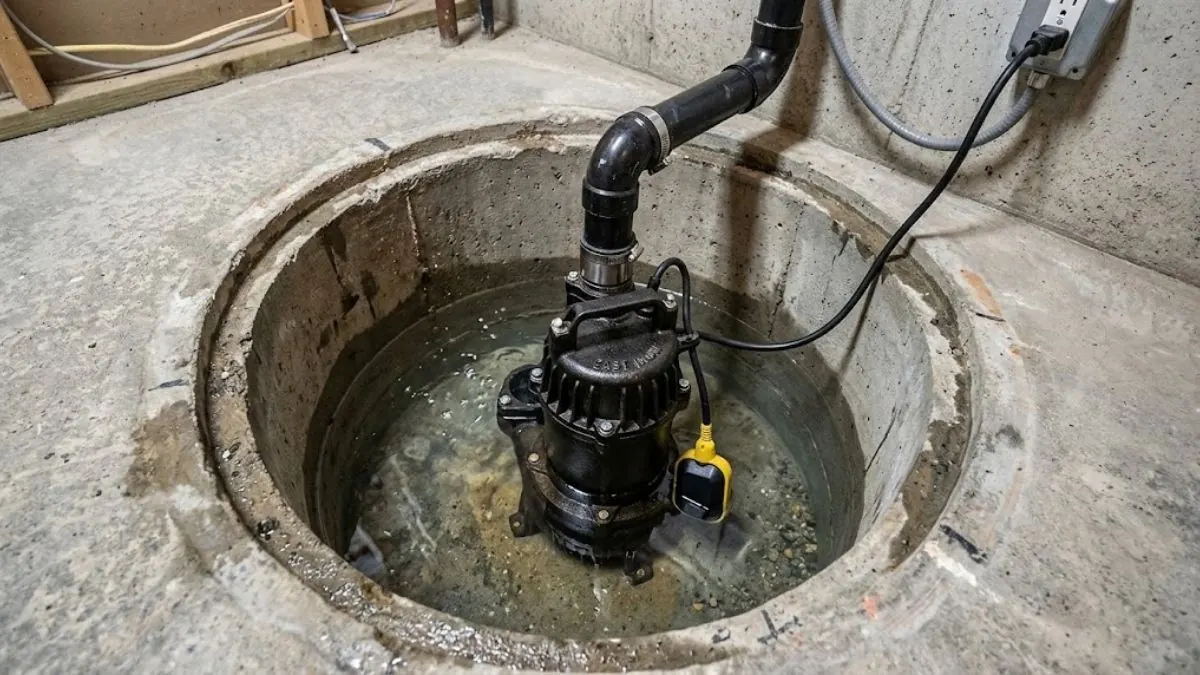
First, does your home even have a sump pump?
A sump pump sits in a pit, usually in a basement or low utility area, and pumps groundwater away from the foundation. Not every house has one. We have not found a reliable local source on which foundation types are typical in Morrisville, so we will not guess.
Check your own home. Look for a round plastic or concrete pit with a lid in a basement, garage or utility room, plus a discharge pipe leaving the house. If you do not see one, you can skip the rest of this page. If you want to know whether water is a risk at your address, see basement waterproofing.
What a float switch does
The float is the part that tells the pump when to run. It rises with the water in the pit and closes a switch at the top level, then drops and opens the switch at the bottom. Two styles are common. A tethered float swings on a cord and a vertical float slides up and down a rod.
Because the float lives in water, it collects debris, soap and sediment, and it can wedge against the pit wall or the discharge pipe. A float that cannot move is the same as a switch that has failed, and the pump will behave the same way.
| What happens | Float cause to check | First step |
|---|---|---|
| Pump never starts while the pit fills | Float stuck low, wedged or worn switch | Lift the float by hand with a broom handle and watch for the pump |
| Pump runs constantly | Float stuck in the on position, or no slack in a tethered float | Disconnect power, look for a jam, free it or reposition it |
| Pump turns on and off every few seconds | Float riding too close to the pump or check valve backflow | Check float position and the check valve |
| Pump hums but water does not leave the pit | Not a float fault, likely a jammed impeller or a frozen or blocked discharge | Unplug and have a plumber inspect it |
Test the float, safely
Always unplug the pump before you reach into the pit. Unplug the float switch cord from the piggyback plug, then plug the pump cord directly into the wall outlet. If the pump runs, the motor is fine and the float switch is the likely fault. Do not leave it running that way for more than a few minutes, because a dry pump overheats.
A second test uses a non-conducting stick, such as a broom handle. Lift the float to its on position while the pump is plugged back in through the switch. The pump should start. If it does not, the switch or its wiring is at fault.
A practical order for the check.
- 01
Cut power
Unplug the pump and float. Never work in a wet pit with the pump powered.
- 02
Look for a jam
Remove the lid and check for stones, debris or a wedged float. Make sure a tethered float has at least about 3 inches of cord free between the ball and its bracket.
- 03
Run the direct test
Plug the pump directly into the wall for a few seconds and confirm it pumps water out of the pit.
- 04
Decide repair or replace
If the pump runs directly, replace or free the float. If it does not, the pump needs service or replacement.
When to free it, replace it or replace the pump
Rules of thumb that save money
- Free the float and clean the pit if debris was the cause and the switch clicks normally.
- Replace only the float switch when the pump runs on the direct test and the old switch is worn or sticky.
- Replace the whole pump when the motor hums without pumping, trips the breaker, or the unit has been running poorly for years.
- Consider a pump with a vertical switch or an electronic switch if the pit is narrow and a tethered float keeps tangling.
Washing machine or laundry water changes the choice. A pump that handles laundry discharge should be an effluent style with a tethered switch, because soap scum can lock a vertical float in place. Our sump pump repair page covers installs and replacements.
Local flood facts and why backup power matters
Why a Triangle sump pump needs power during big storms
The Wake County Hazard Mitigation Plan, adopted in October 2024, records 231 flood events across the county between 1996 and 2023. Morrisville appears in the plan's flood event list. When Hurricane Fran hit in September 1996, the National Weather Service recorded 8.80 inches of rain and a 79 mph gust at Raleigh-Durham airport, and about 1.5 million people lost power across the state.
The practical lesson is simple. A sump pump only works when it has power, so a float that is perfect on a dry day does nothing during an outage. If you have a pit, test the float before storm season and ask a plumber about a battery backup pump as a second line of defense.
Sources: Wake County Hazard Mitigation Plan and the National Weather Service Hurricane Fran summary.
Standards and safety around a sump pit
Replacement pumps are plumbing work under the 2024 North Carolina Plumbing Code, based on the 2021 International Plumbing Code (IPC). Treat the pit as an electrical hazard: unplug the pump before you reach in.
Ask the Town of Morrisville Inspections Department at 919-463-6190 where discharge is allowed.
Call (919) 944-7281 for a licensed plumber to test the float, the pump and the discharge line.
If the pit is full right now
Water rising in the pit with a dead pump is a time-sensitive problem. Move stored items off the floor, keep electrical devices away from standing water, and do not step into a wet basement with power on. Our dispatch line works 24/7.
If you are in Durham and have a pit, the same advice applies. See our Durham page for how we cover that side.
Questions about this topic
If the pump runs when plugged directly into the wall but not through the float switch, the float switch is the likely cause. Also look for a float that is jammed or tangled in the pit.
Yes, when the motor runs on the direct test. Match the switch type, tethered or vertical, to your pump model and your pit size.
We cannot say. A reliable local source for foundation types in Morrisville was not found, so check your own home for a pit with a lid and a discharge pipe.
A float stuck in the on position is a common cause. Disconnect power, check for a jam, free the float and confirm a tethered float has slack on its cord.
Then this page does not apply. Moisture in a crawlspace is a drainage, grading or vapor problem, and our basement waterproofing page explains how we diagnose it.
If you have a pit and a history of power loss in storms, a backup is worth discussing. It adds a second pump and a battery that runs it when the main power fails.