The short answer, by symptom
| What you see | Likely cause | Usual first choice |
|---|---|---|
| One sink or tub drains slowly | Hair or soap in the trap arm | Hand tool or small cable |
| A toilet clogs once and clears | A single obstruction | Toilet auger or closet cable |
| Same clog returns every few weeks | Grease or scale lining the pipe | Hydro jetting |
| Several fixtures back up together | Blockage in a shared or main line | Cable first, then camera, then jetting if needed |
| Gurgling plus slow drains after a heavy rain | Roots or a damaged line | Camera inspection before either method |
That table is a starting point and not a diagnosis. Two identical symptoms can have different causes, which is why a camera look matters whenever the problem is not a one-fixture clog.
How a drain snake works
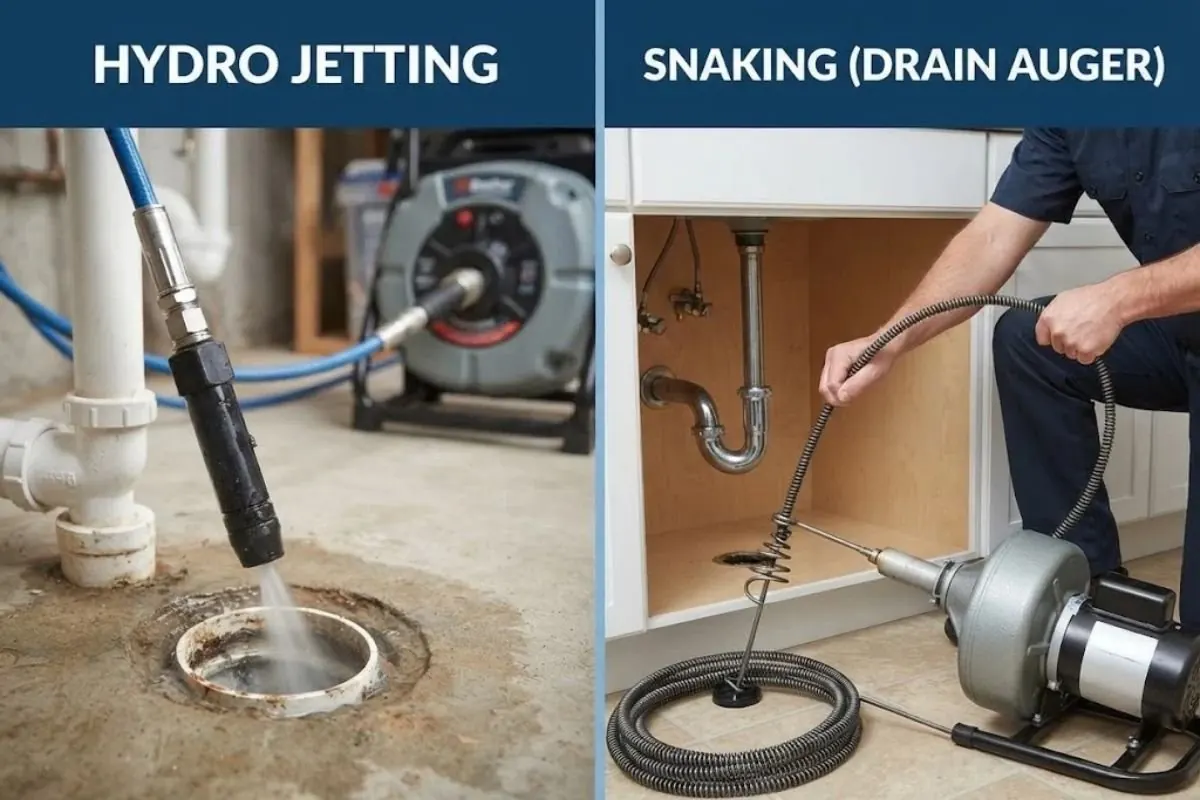
A drain snake is a coiled steel cable with a tip shaped for the job, such as a spear, a cutter blade or a retrieving hook. A motor spins the cable while the plumber feeds it through the line. The tip breaks the clog apart or hooks it so it can be pulled out.
The method is fast, inexpensive in terms of equipment, and effective on a solid blockage such as a wad of hair or a stuck toy. What it does not do is clean the pipe wall. It leaves a channel through the clog, and the film around that channel stays.
How hydro jetting works
A jetter feeds a flexible hose with a specialty nozzle into the pipe and sends pressurized water through it. Forward jets break up the clog, and rear-facing jets scrub the pipe wall and push debris back toward the opening. The nozzle is chosen by the pipe size and what is lining it.
This clears grease, soap scum, scale and many types of root growth more completely than a cable. Our hydro jetting page covers the equipment in more detail, including why a camera run comes first.
Where each method falls short
Honest limits
- A snake can bore a hole through grease and leave the rest of the coating in place, so the clog returns.
- A cable can scrape or catch on a damaged section of an old pipe.
- Jetting is not suited to a pipe that is cracked, collapsed or separated, because high-pressure water can worsen the damage or flood a void.
- Jetting needs an access point such as a cleanout, and sometimes a toilet must be pulled to get in.
- Neither method repairs a broken or sagging pipe. They only clear it.
This is the reason diagnosis comes before the tool. A short camera run tells the plumber whether the pipe is sound enough for jetting or whether a cable is the safer first move.
Morrisville note: grease is the clog you can prevent
Cary, which provides Morrisville's sewer service, runs a fats, oils and grease program, and its curbside cooking-oil collection is for Cary solid-waste customers only. Morrisville trash and recycling is handled through the Town by GFL, so Cary directs Morrisville homes to drop used oil at a Wake County Multi-Material Recycling Facility instead.
That is the practical tie-back to the jetting question. Grease is exactly what builds a coating that a cable cannot remove, so keep used cooking oil out of the drain and take it to a Wake County facility. Property managers of apartments or townhomes can ask Cary's Utility Pretreatment Program about collection events.
Source: Town of Cary, fats, oils and grease control in the home, and Town of Morrisville, New Residents.
How a plumber decides
A sensible visit follows this order.
- 01
Ask and look
Which fixtures are slow, how long, and whether it has happened before.
- 02
Try the simplest tool
A cable on a one-fixture clog often finishes the job in one pass.
- 03
Run a camera
If the clog returns or several fixtures are affected, see the pipe wall before choosing.
- 04
Jet or repair
Jet a coated but sound pipe. Plan a repair if the camera shows a break.
For a plain slow drain, our drain cleaning page lists what a standard visit covers and when we step up to jetting.
Roots, older pipe and the camera question
Tree roots enter a line at joints, grow into a mat, and catch everything that passes. A cutter head on a cable can chop the mass, and a jetting nozzle can shear it and flush the pieces. Both leave the root where it entered, so roots grow back unless the joint is sealed or the pipe is repaired.
Older pipe adds another question. Cast iron can develop rough scale inside that traps debris, and clay or fiber pipe can have separated joints. Jetting cleans scale well, but a camera should confirm that the pipe is sound enough before high pressure goes in.
A camera head on a push cable also leaves you with a record. If the footage shows a belly where water sits, no method of cleaning will cure the repeat clogs, and the conversation moves to sewer line repair.
Cost factors for each method
Snaking is usually the lower-cost option because the equipment is lighter and the job is quicker. Jetting uses larger equipment and more time, so it generally costs more per visit. The better comparison is cost over a year, since a cable on a greasy line can be a repeat purchase.
Other factors include where the access point is, how long the line is, and whether a camera is included. Ask for the price before work starts and ask what it covers.
Call (919) 944-7281 and describe the symptom. A licensed plumber can say whether a cable, a camera or a jetter fits.
Households in south Durham can reach us too. See the Durham page for how we dispatch from Morrisville.
Questions about this topic
Better at cleaning, not always better for the job. Jetting removes the film that causes repeat clogs, while a snake is faster and fine for a single obstruction. The right call depends on what the pipe looks like inside.
On a sound pipe, correctly set pressure is safe. On a cracked, collapsed or badly corroded pipe, jetting can make the damage worse, which is why a camera look comes first on older or suspect lines.
A cable opens a channel but does not scrub the wall. If grease, scale or roots line the pipe, the channel closes up again, and jetting or a repair is usually the next step.
Consumer pressure washers with drain hoses exist, but a plumber's jetter runs much higher flow and pressure, and a mistake can push water out of the cleanout or into a weak pipe. For a stubborn main clog, a licensed plumber is the safer route.
Cary says its curbside cooking-oil collection is for Cary solid-waste customers only, and Morrisville homes should instead drop used oil at a Wake County Multi-Material Recycling Facility. Keep it out of the drain either way.
Not for every clog, but it is wise when clogs repeat, several fixtures are affected, or the house has older piping. The camera shows whether the pipe can take the pressure.