Disposal jammed, humming or leaking right now
A humming unit that will not turn almost always has a jam. Something hard, like a bone, a peach pit or a bottle cap, has wedged between the impellers and the shredder ring. The motor tries to turn, hits the blockage, and trips the thermal overload to protect itself.
That red reset button on the bottom is a safety device, not a fix. Pressing it again and again with the jam still in place just heats the motor. Free the jam first, then reset once.
If the disposal is jammed or water is coming out
Do these in order. Never put your fingers in the opening, even when the switch is off.
Cut the power
Turn the wall switch off, then unplug the cord under the sink or turn off the breaker. A disposal that starts on its own is an injury risk.
Look from above
Use a flashlight and tongs to remove visible objects such as bottle caps or utensils. Do not reach in by hand.
Turn the hex socket
Many units have a hex socket in the bottom center. A half-inch hex key rotated back and forth frees most jams.
Leaking? Close the valves
If water is dripping from the unit, close the sink stop valves, empty the cabinet and call (919) 944-7281.
Reading the symptoms
| Symptom | Likely cause | Repair path |
|---|---|---|
| Hums, will not spin | Jam or seized motor | Free with hex key, replace if the motor is seized |
| No hum, no movement | Tripped overload, dead outlet or burnt motor | Reset once, check the switch and cord, then replace if dead |
| Leaks from the top flange | Failed putty or seal at the sink | Remove the unit and reseal the flange |
| Leaks from the side or bottom | Cracked housing or failed internal seal | Replace the unit |
| Leaks at the drain pipe | Loose slip nut or worn gasket | Retighten, replace gasket |
| Sink fills with water and drains slowly | Clog past the disposal in the drain line | Clear the line with a cable |
| Strong smell | Food residue stuck in the chamber | Clean thoroughly, check the dishwasher hose |
Dishwasher hose, sink drain and what else is connected
A disposal does not work alone. The dishwasher drain hose connects to a small knockout port on the side, and if that knockout plug was never removed after installation, the dishwasher cannot drain. Water then sits in the dishwasher and smells.
The other connection is the sink drain itself. A disposal sends ground waste into a pipe that was not built for grease and starch. If the sink fills when you run the unit, the clog usually sits past the disposal, and we follow it with a cable. Drain cleaning handles the rest of the line when the blockage is deeper.
What goes in, and what does not
Cooking oil and disposals in Morrisville
A disposal chops food, but it does not make grease safe for the sewer. Cooking fat cools inside pipes and builds up, and Cary's sewer program asks households to keep fats, oils and grease out of drains. Cary's curbside cooking-oil pickup is for Cary solid-waste customers only, and Morrisville trash and recycling is handled by GFL through the Town.
For used oil from a Morrisville home, the alternative Cary lists is dropping it off at a Wake County Multi-Material Recycling Facility. Pour cooled oil into a sealed container, drop it off there, and wipe greasy pans with paper before washing. If you manage an apartment or townhome community, Cary lists its Utility Pretreatment Program Supervisor at (919) 319-4564 for questions about collection events.
Source: Town of Cary, fats, oils and grease at home
Keep out of the disposal
- Grease, oil and fat from cooking
- Coffee grounds in large amounts, which pack into a sludge
- Pasta, rice and potato peels that swell with water
- Bones, fruit pits and shells that jam the impellers
- Fibrous vegetables such as celery and corn husks
Repair or replace the unit
A jam, a loose gasket or a tripped overload is a repair. A seized motor, a cracked housing or a unit with rust leaking from the side is a replacement. Most residential units are 1/3 to 1 horsepower, and the higher horsepower models run quieter and handle more, but they also fit a tighter cabinet less easily.
We tell you what we find before swapping anything. If the unit is simply jammed, freeing it costs less than a new one and takes much less time. If it is leaking from the body, no sealant will hold.
Safety guidance before you touch a disposal
Never put a hand into a disposal, even when it is off. Switch the breaker off, use tongs or pliers to remove a jammed object and turn the hex socket on the bottom with an Allen key to free the flywheel.
A new disposal install follows the 2024 North Carolina Plumbing Code, based on the 2021 International Plumbing Code (IPC), so ask about the drain connection and electrical rules that apply.
Call our 24/7 line and we will arrange the earliest visit we can.
How a disposal installation goes
A replacement usually fits in a single visit when the sink and wiring are sound.
- 01
Power and drain off
We disconnect the power, close the water if needed, and remove the old trap and drain parts.
- 02
Remove the old unit
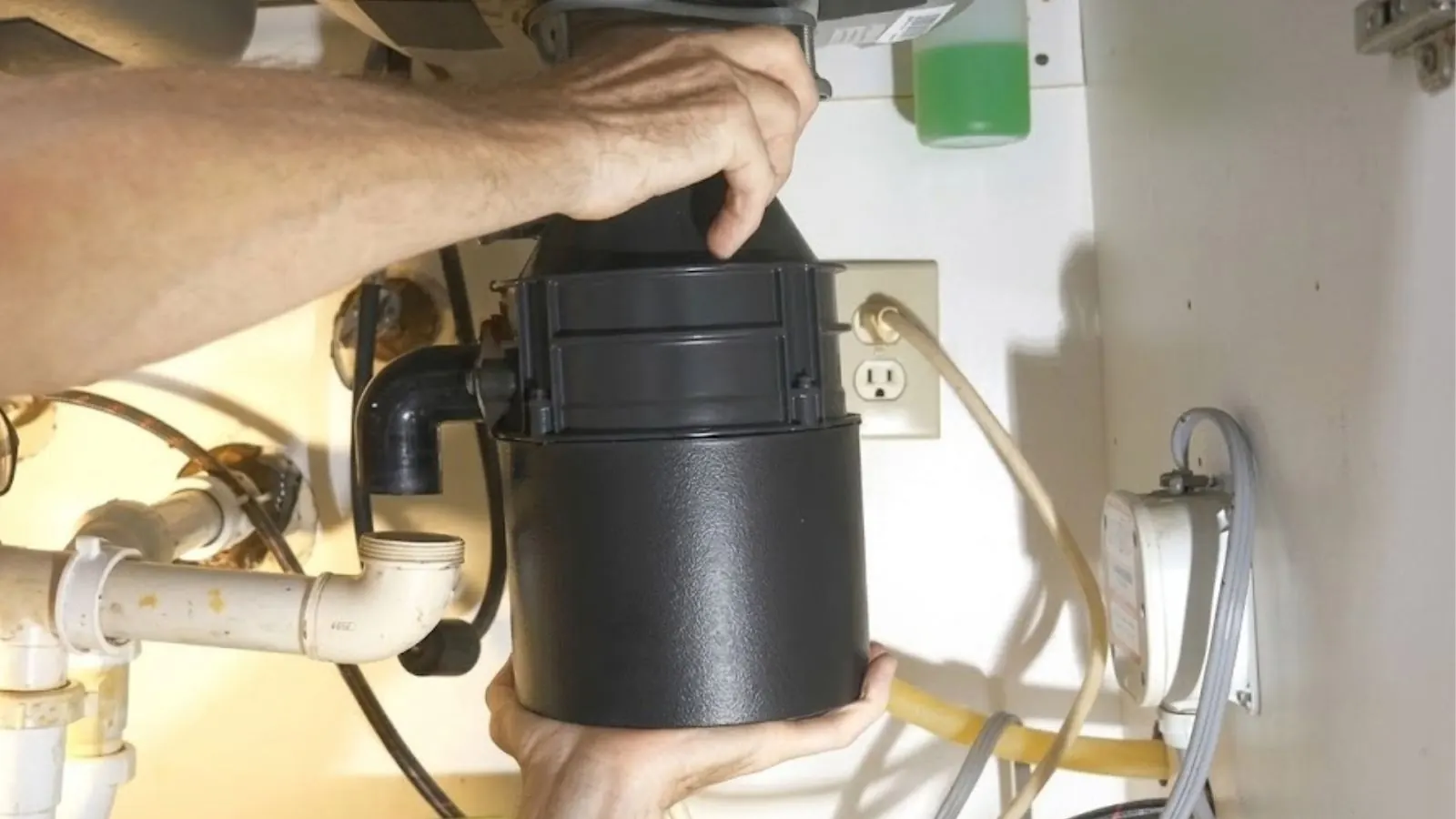
We twist the mounting ring free, lower the old unit and scrape the old putty from the sink flange.
- 03
Mount the new one
We seat the new flange with plumber putty, tighten the mounting ring and hang the unit.
- 04
Reconnect and test
We reconnect the drain and dishwasher hose, restore power, and run water through to check every joint.
Electrical work is where we stay in our lane. A switched outlet under the sink or a hardwired connection is common, and if wiring needs correction we point you to a licensed electrician rather than guessing. If the sink faucet or supply lines are also tired, we often combine this with faucet and sink repair.
What changes the price of disposal work
We quote a clear price before work starts. The usual factors:
Repair or replacement
Freeing a jam is quick. A new unit adds the cost of the disposal and the fittings.
Unit size and type
Horsepower, feed type and sound insulation vary widely.
Sink and plumbing condition
Old putty, a corroded flange or a cracked trap can add work.
Electrical setup
A cord and outlet install faster than a hardwired connection.
Clogs past the disposal
A blocked line needs a cable and adds a separate service.
Insurance rarely covers a worn-out disposal, though water damage from a sudden leak may be covered. Ask your insurer.
Questions we hear
Yes. Dispatch answers 24/7, and a licensed plumber can usually visit the same day when available. Cut the power and close the stop valves if water is leaking, then call (919) 944-7281.
Probably not. A hum means the motor has power but the impellers are jammed. Turn the power off, use a hex key in the bottom socket to free it, then press the reset button once.
It depends on use and what goes down it. Rust at the seams, constant leaks or a motor that keeps tripping all suggest it is near the end. A plumber can look at it and tell you honestly.
Avoid both. Grease hardens in pipes, and large amounts of grounds pack into sludge. Cary recommends keeping fats and oils out of drains.
The knockout plug in the disposal's dishwasher port may still be in place. We remove it during installation, and we can check the hose connection on any visit.
Yes, and a landlord or property manager can call with the unit address and the tenant's contact. We cover the commercial side on our commercial plumbing page.