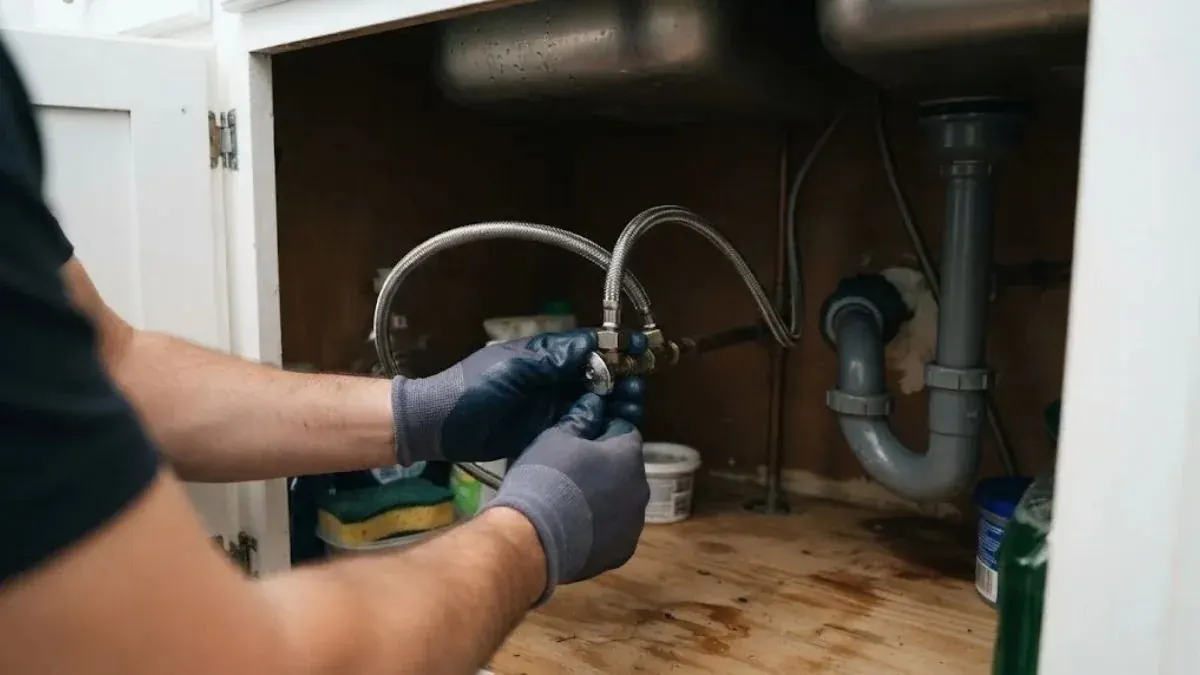
The parts, from the wall to the drain
| Part | What it does | Common failure |
|---|---|---|
| Angle stop valves | Shut off hot or cold to this sink only | Slow drip at the stem, or stuck and will not close |
| Supply lines | Braided hoses from stop to faucet | Leak at the nut, frayed or kinked braid |
| Pop-up assembly | Lever and stopper at the drain | Slow leak at the nut or a stopper that will not seal |
| Tailpiece | Short vertical pipe from the drain down to the trap | Loose slip nut |
| P-trap | Curved pipe that holds water as a seal | Leak at slip nuts, clog, or cracked bowl |
| Trap arm and wall stub | Carries waste into the wall drain | Poor slope, loose escutcheon, corrosion at a metal stub |
Between the water lines you also find the faucet's mounting nuts and, on some sinks, a small overflow channel inside the basin that connects to the drain below. A leak that appears only when the basin is nearly full often comes from that overflow path.
How to find a leak in under five minutes
- 01
Empty and dry the cabinet
Take everything out and wipe the base so a fresh drip is easy to see.
- 02
Wrap dry paper towel
Wrap each joint with a dry paper towel, one at a time, and run the water briefly.
- 03
Check supply, then drain
Open the tap for hot and cold and look at the supply nuts. Then fill the basin and release it to test the drain joints.
- 04
Look up, not just down
A drip from the faucet body or the mounting nuts runs down the pipe and shows up lower than it started.
Run the test in that order. Supply leaks show up while the water is running at the tap, and drain leaks show up when you release the basin. That tells you which set of joints to check.
The P-trap, and why it is shaped that way
The curve keeps a few inches of water standing in the pipe. Sewer gas cannot pass through it, which is why a bathroom that sits unused for weeks can start to smell when the trap dries out. Run the tap for a minute and the smell often goes.
Slip nuts on a trap use a washer that seals when snug. Hand tightening plus a quarter turn is usually right. Cranking hard cracks plastic nuts.
A slow drain is often the same cabinet
Hair and soap film collect in the pop-up assembly and at the bottom of the trap. Pull the stopper, clean it, and check the trap with a bucket under it. That fixes most sluggish sinks.
If water still backs up after cleaning, the blockage is farther down the line. That is when a drain cleaning visit with a small cable machine makes sense, rather than pouring chemicals into a pipe you can no longer see.
Morrisville tap water and your faucet
Cary's 2025 water testing summary lists the hardness of the water it supplies, which serves Morrisville, at about 30 mg/L as calcium carbonate, classed as moderately soft. In practice that means heavy mineral crust on a bathroom aerator is less common here than in hard-water areas.
So if you see white crust building around a faucet base or a supply nut, treat it as a clue to check for a slow seep at that joint, not as normal scale.
Source: Cary 2025 Drinking Water Detailed Report, checked October 2026.
Repairs you can do and repairs to hand off
Reasonable to try yourself
- Tighten a slip nut a quarter turn and re-test.
- Replace a braided supply line, after closing the stop valve.
- Clean the pop-up stopper and the trap bowl.
- Replace a worn faucet aerator.
Call a plumber when
- The angle stop will not close or drips from its stem.
- The wall stub is corroded, or the cabinet floor is swollen.
- A leak returns after you replace the washer or hose.
- Water comes out of the wall, not from a visible joint.
For faucet bodies, cartridges and stops, see our faucet and sink repair service. A stop valve that will not shut is more than a nuisance, because it is your emergency shutoff for the whole sink.
Corrosion and old parts
Chrome-plated brass and steel traps can corrode from the inside, and the first sign is a damp patch at the bottom bend. Plastic traps do not corrode but yellow with age and crack at the threads.
If a metal trap has gone green or white at the joints, replace the whole assembly, not just a washer. Mixing metals at a wall stub can start galvanic corrosion, so ask a plumber to match materials.
Under-sink storage that causes leaks
A cabinet full of cleaning bottles hides a leak for months. Wet cardboard, a swollen particleboard floor and a musty smell are the usual clues. Keep a small shelf or a plastic tray in the cabinet so a drip lands somewhere visible.
Check the flexible supply lines every year or two. Braided stainless hoses outlast rubber ones, but the fittings still wear. A hose with a bulge or a rust bloom at the nut should be swapped before it fails.
When the sink is not the only problem
If the sink drains slowly and so do the tub and a second bathroom, the problem is not in the cabinet. A shared branch line or main drain is partly blocked. Our drain cleaning team uses a cable machine or hydro jetting depending on what the line holds.
We also serve homes in Durham from our Morrisville base. See the Durham page if your address is on that side of the line.
Quick reference before you call
Have these ready
- Whether the leak shows with water running, or only when the basin drains.
- Whether the angle stops close fully.
- The age and material of the trap, metal or plastic.
- A photo of the joint that looks wet.
Code notes for what sits under a sink
The traps, supply valves and drain lines under a sink are installed to the 2024 North Carolina Plumbing Code, based on the 2021 International Plumbing Code (IPC). Repairs that stay like-for-like are usually simple, but any rerouting is worth a plumber's eye.
Check for corrosion on the shutoff valves and replace them if they do not close fully.
Call (919) 944-7281 and describe what you see. We can usually tell you whether it is a tighten-and-test fix or a part to replace.
Questions about this topic
From the wall in: angle stop valves, supply lines, the pop-up assembly, tailpiece, P-trap and trap arm into the wall stub.
A dry P-trap lets sewer gas up, so run the water for a minute. If the smell stays, hair or film in the trap or pop-up may be the cause.
Yes, a quarter turn past hand tight is usually enough. If it keeps weeping, the washer or the pipe end is worn and the part should be replaced.
It can be mineral residue or a sign of a slow seep. Cary reports its water as moderately soft, so a heavy crust is worth a closer look for a leak.
Turn the angle stop valves under the sink clockwise. If they will not turn or keep dripping, they need replacing.
Often yes with plastic parts and a bucket. If the wall stub is corroded or the trap connects to old metal pipe, get a plumber.